THE GRAND LITTLE RUNN
Updated: Jun 30
February, 2025




Wild Ass Country
Our dark-olive steed, all rippling muscle and bulging vein, gleams in the vigorous morning sun as it gallops with frenzied zeal across the immense drylands, leaving behind a cinematic tornado of thick, fine wild-west dust.
The two cowboys and a cowgirl, epic explorers of these lawless lands, twirl their lassoes as they bounce along, their derrières frequently and gallantly launching into the air.
With experienced ease, they scan the land for feral horses.
Every little detail in this fantastical picture is real, except that lassoes are cameras and binoculars, our steed is a rattling old jalopy of a Maruti Gypsy, the drylands are seasonal salt marshes — arid, hard, cracked — and we seek not feral horses but wild asses.
The derrière part is true too, only that its frequent launching and depositing feels far from gallant. This is one of those situations when one wishes one had a more generous behind, a more cushiony bottomline so to speak.
We are somewhere in the Indian Wild Ass Sanctuary (IWAS), at 5,000 sq km much bigger than all of Goa and a little smaller than Sikkim, in the Lesser Runn of Kutch (LRK).
IWAS is possibly the only place on the planet that is home to Equus hemionus khur, an endangered donkey species. Equus is Latin for horse, and hemionus, derived from Greek, means ‘half-mule’.
When we finally come face to face — though in the initial moments of the encounter, the wild asses show us only their wild asses — these curious creatures do look to be somewhere between an unfinished horse and a refined donkey.
Evolution, like all the finest artists, seems to be permanently temperamental and periodically stoned. Evolutionary artwork can be truly baffling.
We spend some serene moments of silent communion with the wild asses — us gazing, them grazing — before the captain of our Gypsy decides to sputter off towards more adventure.
This rather forbidding and unlovely landscape, we are soon to realise, is actually a ceaseless splendour of species.




The Pink Celebrity
Divan Ikbalsha Alamsha, our aristocratically named captain, jolts to a scrunching halt not far from the edge of a waterbody. The entire frame of this weatherbeaten veteran — the Gypsy, not the Divan — rattles for a few seconds, as if in the throes of an epic death, its many cables dangling and jangling.
I am reminded of what a friend had once said about my old car: “Iska horn chhorke sab bajta hai.”
Divan, who prefers to be called Ikbal, in elaborate sign language directs us to crawl up a little mound — intriguing, given that he just let half of LRK know that we are here.
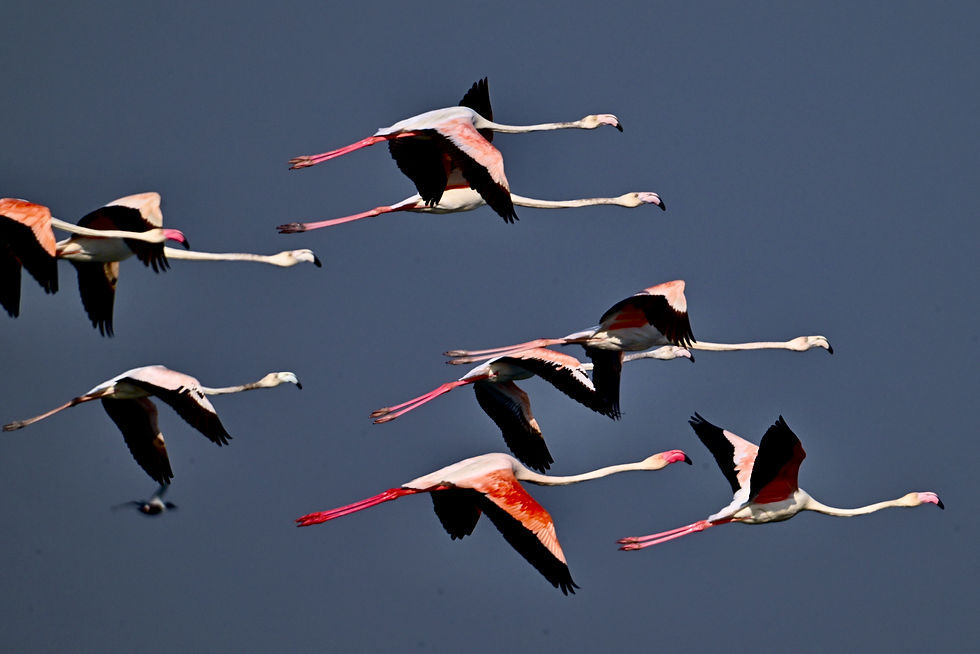
As we laboriously reach the peak of the two-foot embankment, the scene morphs into an entirely different universe. There sits like a saucer a small, lucid lake sprinkled with white and pink: Greater and Lesser flamingoes. A few are foraging, their beaks upturned under water, quite close to us, their blood-shot eyes emerging every now and then.
Even more noticeable are their remarkably long legs in bright wet pink-red, as if the paint has not yet dried. When they huddle together, the legs look like animated line drawings.
“Birds bend their knees backwards so that they can move noiselessly in the water. We humans can only bend our knees forward,” a naturalist had once proclaimed. His assumption, an honest error, is excusable.
In truth, what appears to us as the bird’s knee is actually its ankle.
On an island strip in the little lake sits a pair of White storks, also with red legs but duller, a flock of Indian cormorants engaged in gular fluttering — throat vibrations to keep cool — and a couple of juvenile flamingoes yet to acquire pink in their plumage.
Further away, there’s a larger flock of flamingoes and a lot of excited shimmer around their feet. Ikbal urges us to use our binoculars. Pied avocet, hundreds of them, with their strikingly curved bills!
These black-white birds mill around the flamingoes persistently, often causing the much larger, leggier wader inconvenience and annoyance.
LRK is a prominent spot in the migration route of winterers that fly in all the way from places like Egypt, Iraq, Tibet, Siberia and Europe.
Ikbal decides to set off again, this time into the horizon, racing against the sunset, trying to get us somewhere before nightfall. It takes immense effort to not get flung flying off the roofless car.
I do fancy a chivalrous, climactic end in the vast wilderness, but I have different situations in mind, all of which involve a dangerous wild animal and a damsel in distress.
At this moment, at this velocity, in LRK, I feel I am that damsel.
Ikbal, in his typical style, once again comes to a jolty stop and then calmly points to the water. We jump out instantly and dogtrot close enough to observe without disrupting: in a tidy line, about a dozen flamingoes are plodding on purposefully, synchronously.
They stop after a while, preen themselves for a few minutes, bury their long necks into their feathers, and then lift a leg. They jerk it a few times, as if shaking off a dream, and then doze off. This is bedtime.
After raising big dust in this immense nowhere, now out here crouching gingerly, we feel that we have met the moment.
The world, for now, feels quieter, kinder, bigger.


The Grey Voyager
Somewhere around the bend is something peculiar: the chorus is urgent, persistent and croaky, like a thousand frogs down with influenza frantically praying to the heavens to not let them die virgins.
We are raising dust once again, but now on a bumpy, broken village road somewhere between LRK and Nal Sarovar, the largest wetland bird sanctuary in Gujarat.
Our wildlife guide this time, let’s call him R, is a prodigious prevaricator who redeems himself to an extent by also being prodigiously informed about bird life. He can identify species from afar, tell you in detail why that sparrow-looking bird is not a sparrow but the Greater short-toed lark — thousands of them in the fields — and lead you through snaky alleys into the epicentre of that croaky cacophony.
His first big fabrication happens even before he arrives, that he would be right on time and the car would be newish and comfortable. He arrives close to an hour late, claiming he got lost in a terrain that he later claims he traverses every day.
And if that Gypsy was a jalopy, his Eeco turns out to be in a post-jalopy stage.
Possibly yanked out of its deathbed, the contraption shudders and judders every few minutes, annoyed that it is being forced to stay alive. The windows refuse to roll up, one can’t pry open the doors from the inside, and the equally ancient driver has to press hard to change gears.
The seat upholstery however is shiny, velvety, new.
The Eeco stops on a forlorn patch of land, R steps out, and then asks us to follow him. “Be very quiet,” he says. That’s wise counsel, but one that doesn’t apply to him. He is busily jabbering away on his phone.
Thankfully, that’s a minor irritation given the sight that we are about to behold.
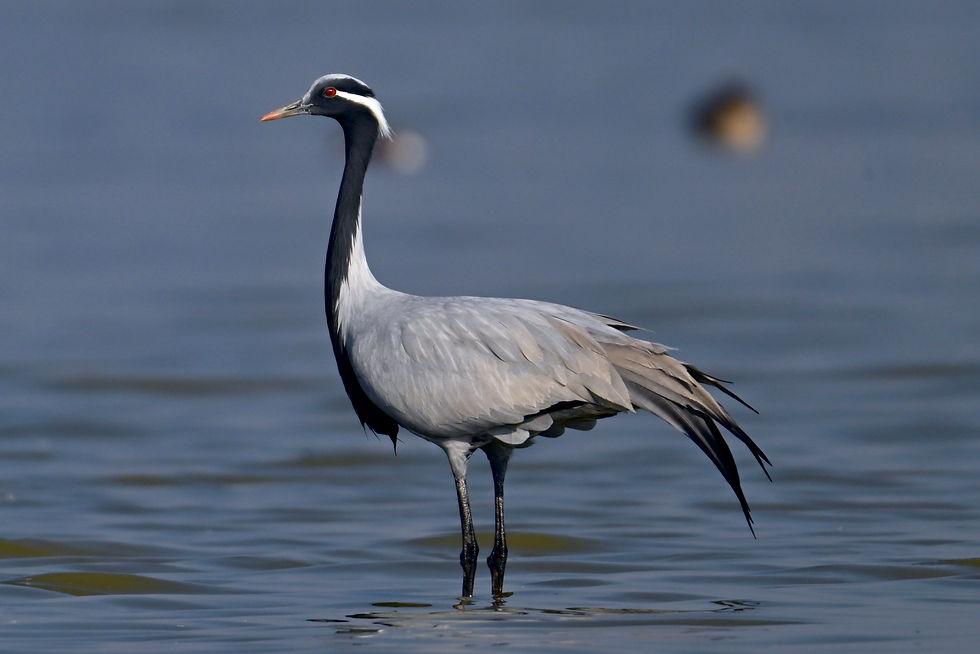
We are staring, numbly, at an enormous revelation: thousands upon thousands of large birds which seem to have been designed by a sophisticatedly minimalistic fashionista. They have graceful grey plumage, a black silky cravat down the neck, white ear tufts and, to add contrast, flaming red eyes.
Demoiselle cranes, Grus virgo.
A rough count indicates that there are more than 5,000 of them here in this little lake, their favoured roosting site this winter. There are hundreds more flying in, their necks stretched and their legs splayed, landing wherever they can, causing raucous realignments.
Grus is Latin for crane, and Virgo is Latin for virgin or maiden.
In some parts of India, demoiselle cranes are called kraunch or koonj, a word often used to describe women in a reference to the crane’s slender shape.
They even find mention in the Mahabharata: both the Pandavas and the Kauravas had used the V-shaped kraunch infantry formations.
According to wikipedia, the English naturalist and watercolourist Eleazar Albin wrote: "This Bird is called Demoiselles by reason of certain ways of acting that it has, wherein it seems to imitate the Gestures of a Woman who affects a Grace in her Walking, Obeisances, and Dancing.”
Eleazar meant it then as a glowing compliment. He couldn’t have anticipated how his analogy, the obeisances part in particular, would be received today.
We shall not delve into sexism and semantics any further, lest this detract from the hypnotic stateliness, entrancing elegance of the demoiselles.
Truly mesmerising, given the word’s origins: Franz Mesmer, an 18th-century German physician who came up with a theory about an invisible magnetic fluid that caused ‘animal magnetism’, a force that could be used to influence others, cause hypnosis.
When you are looking at the demoiselles, you will get carried away. Eleazar knew that feeling, just that he might have gotten carried away a little too far.


Wandering, Wondering
Each time we go out with R, there’s a customary stop at Upsarpanch Chaha, a popular jaggery-tea roadside chain in Gujarat.
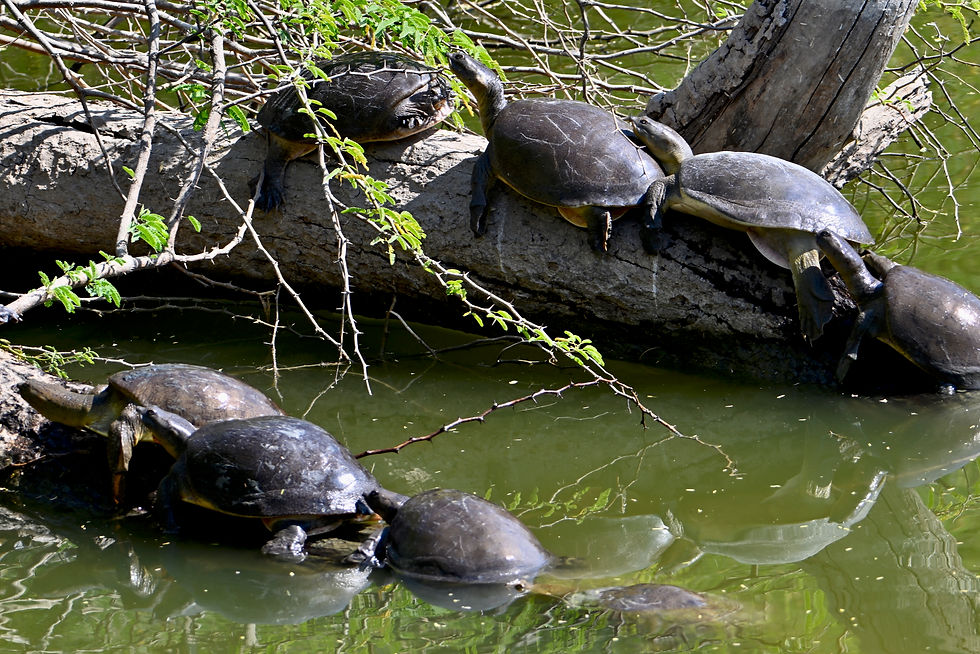
The chai gives us pause to reflect on the beauty of all that we have seen, first the cranes and then the biggish turtles that line up tidily for their sunbath siesta on a wooden log in a village pond.
The cosy bum-pillow arrangement gets disrupted only when an overeager turtle tries to wiggle its way in. Someone topples into the water, others adjust their bums and heads, and the slumberous, sun-drenched calm resumes.
The chai break also gives us a moment to figure out how to cope with all the manufactured menaces that seem to be steadily creeping up on everything, everyone.
There’s the bunch of young boys, around 10 year old, who are always milling around Upsarpanch, chewing gutka — victims of the scourge of the ubiquitous sachet. When asked why they eat it, and if they know how harmful it is, they just smile sheepishly.
The profit motive, the single-largest force that drives the world now, is ruthless. It has the power to consume whatever lies in its path: tree, land, human, water, animal.
Then there are those feral dogs, a serious threat to waterbirds, who keep darting into the lake to catch a crane, causing massive panic. There are an estimated 60 million strays in India, most of them forced to fend for themselves any way they can.
And what is the number of grey wolves, the species that humans domesticated into dogs, left on the entire planet? Around 200,000.
The population of grey wolves is steadily declining, and those of stray dogs steadily rising, and neither is responsible for this predicament.
Finally, of course, like those sachets, is the rest of the plastic, possibly a more imminent threat than climate change. It is difficult to find a spot even in the uninhabited outbacks that does not have empty water bottles and chips packets callously strewn around.
We cope with the dissonance between the is and the ought by enumerating the species we have seen: Greylag goose, which is named thus because it lags behind other geese when it starts its migratory journey; Siberian stonechat; Pallid harrier; Black-tailed Godwit; Western marsh harrier; Grey Francolin; Crested lark; Greater spotted eagle; Indian spotted eagle; Cotton pygmy goose; Pheasant-tailed jacana; Garganey duck; Knob-billed duck; Common crane; Black-headed ibis; Glossy ibis; and Red-naped ibis.
Another round of chai is sought as the list keeps expanding: House sparrows in flocks of hundreds; White stork; Northern shoveler; Bar-headed goose; Oriental darter; Imperial eagle; Isabelline shrike; Ruddy shelduck; Marsh sandpiper; Common stork; Common hoopoe; Asian openbill; Common kestrel; and Desert wheatear, which, according to AI, was named thus not because of its ear, but puzzlingly because of its ‘white arse’.
One wonders if in AI, only the artificial part is reliable.
One also wonders: Why aren’t humans called lesser or common something, or by the colours of their posterior? Only because they have the privilege of being the ones going about labelling other creatures?
Do other creatures look at us and, given our conduct, in their own vernacular, call us some version of ‘Common arse-headed greater menace’?
More scientifically, Homo nonsensicus destructus?


The Morning Runn
Ayyam, who we register as Khayyam minus the Kh, is barely recognisable. He is wrapped up in a blanket and is wearing a mask. Early mornings in the desert winter can be particularly frigid.
He hands over a blanket to each of us, confirms that he has loaded tea and coffee and breakfast, and leads us to his car — an open Gypsy yet again but, compared to the previous vehicles, in a highly honourable state.
Ayyam is a driver who doubles as an animal spotter, and he’s quite sharp in both the roles.
After getting us quickly through the undesirable drive through a busy highway which leads to tile factories, he enters the Wild Ass Sanctuary and gets us the tickets.
When asked how the forest department manages to regulate entry into a 5,000 sq km expanse, he says the villagers keep an eye.
He stops at a spot, looks up, and points to a crevice in a hut. The spotted owlet gawks back at us. This one’s easy, we think.
The next ones aren’t.
He shows us the large-eyed Indian thick-knee and the Great thick-knee, which are supremely camouflaged among the brambles. It takes us a lot of squinting and frowning, even after Ayyam has pointed them out several times without losing his equanimity.
Thick-knee chicks, we learn later, are nidifugous, they leave the nest shortly after hatching. The opposite is nidicolous.
Humans might qualify as nidiridiculous — many are made to stay in the nest way too long.
We request Ayyam to take us, without further ado, to the flamingoes, and he does. He parks at a distance from the water and indicates the route we should take, bodies bent and in slow-motion, to the water’s edge.
I take his advice seriously — too seriously — and start crawling right away. I know that Ayyam has chaperoned many eminent wildlife photographers, and I have this urge to prove that I am no less.
I already have the trappings. I carry a long camera lens that looks much longer with the lens hood, and I am clad in brown and grey. Not only that, when I park myself behind some bushes, I instantly go prostrate and immobile.
I have arrived.
I smirk at my companions who, I notice furtively, are still standing upright very human-like and looking at the birds through binoculars.
How amateurish!




As Good as Dead
The flamingoes do drift in delightfully close to me, and they are indeed a most fabulous sight, and yes I do think I have managed some shareable shots.
It’s just that after a fair amount of lying, and getting bitten at random spots on my body — I think there are ants in my pants — I am not able to get up, and I am loathe to ask for help. My elbows have dug deep into the wet mud, my neck has become fixed, and the rest of my entire body feels like a fossilised log.
After a few clumsy attempts, hoping that Ayyam and Co are not noticing, I embrace the mud — not entirely out of choice.
I decide to lie there and feel completely connected, head to toe, to Mother Earth — so deeply connected that I am not certain that I am physiologically capable of dislodging anymore.
This is that Buddha moment of great awakening, made even greater by the mosquitoes which are surprisingly courteous, buzzing on and on as if seeking your permission to bite. They might be practising to be politicians in their next lives.
Several realisations happen at once: When you are past 55, you are way past 25; age is not just a number; humans, whatever they do, have to bend to time and nature; and that never again shall we drink much water and coffee just before putting ourselves in these kind of sticky, statuesque situations.
When I finally manage to stir, one toe at a time, and twist and turn and bend so I can get vertical again, I amble towards the Gypsy.
Ayyam welcomes me with a cup of coffee. “It is amazing how you do it, sir. These days anyone with a big camera is a birder. You, sir, are the real thing. You were so good, I thought you were dead.”
Like a seasoned wildlife photographer that I’m pretending to be, I brush off the compliment with a humble, modest shrug. While Ayyam unfurls the breakfast on the Gypsy’s bonnet, urging us to not drop any crumbs, I quickly shuffle away. Nature is calling again, urgently. This one is an internal call.
To pee, or to not pee — that is not the question. The question is, where?
Not far, luckily, is a shadowy spot behind a big-enough tree.


A Boundless Theatre
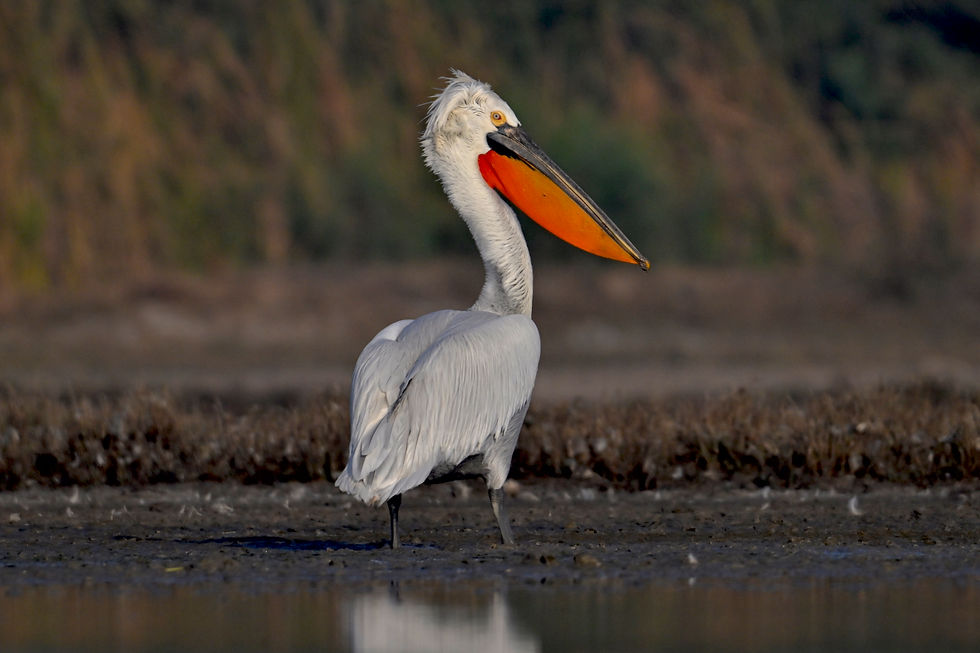
The next morning is spent in the company of Dalmatian pelicans (Pelicans crispus, or curly-headed pelicans), the largest freshwater birds in the world, and its slightly smaller cousin, the Rosy pelicans, in a tiny waterbody in a corner of LRK. A plastic hose dips into the same pond, and a big water pump sits on the mound. A few meters away a house is under construction.
The pelicans are only just rousing themselves from their slumber, their gular pouches jiggling. One or two waddle out a little in the water, their morning walk. In the golden hour, their many motifs — supercilium, plumage, eyes, bill — become even more conspicuous.
Today I am wiser — I bend but I do not sprawl — even if I risk losing some of the wildlife credentials I had earned the previous day.
Ayyam hurries us back into the car, says it’s time for another sighting. He skilfully zig-zags past the shrubs to a cheerless spot which promises nothing. He kills the engine and indicates complete silence.
After a few uneventful moments, two brownish creatures emerge from the earth: Indian foxes, likely sub-adults, melding into the sunburnt cinammon-sienna topsoil.
In this moment of total silence, as a viewer of this grand theatre which runs sometimes on script and sometimes off it, we become sharply aware of an exalting yet humbling sense of submission, immersion and magic.
~*~