A VILLAGE AND A WOMAN
Updated: Sep 25, 2025
June 2023


The first morning opens with a sparkling dialogue between two accomplished orators. The voice modulation is operatic, the enunciation sharp, and the pauses well-positioned.
They are both good listeners too.
I do not comprehend a word, but the sounds suggest a high level of etiquette and attention to grammatical structure. What is being discussed is likely food, home and kids.
This mellifluous domesticity is disrupted by an individual that suddenly parachutes in. This one is loud and intemperate, jabbering to itself like a frustrated philosopher.
The red-vented bulbul pair flies away. The jungle mynah continues its soliloquy for a while in a theatrical vocal range.
Birds don’t just tweet.
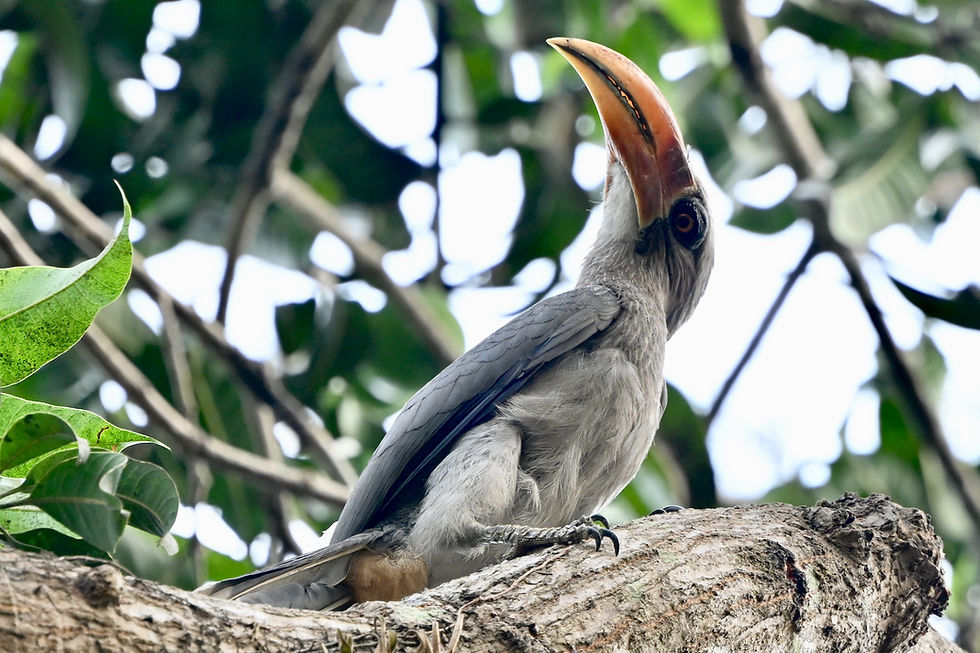
They hoot, quack, chatter, whistle, churr and, like the grey hornbill, laugh so raucously that one might think some drunken, boorish revelry is happening on the treetops.
We are roaming in a five-acre compound in a village. Much of the land is wildish with tall old trees. Coconut, betelnut, pepper, mango, cashew and chiku dominate.
We pick fallen mangoes and dig out raw turmeric and stuff them into the side pockets of my camera bag, which is already sprouting bunches of fragrant curry leaves.
“Let’s get some kokum and bimbli also,” Mrs Bharati Bandodkar tells me.
She has a voice as supple and strong as bamboo. She can make her instructions sound like requests that one feels privileged to fulfil.
We gather the fruits in a coconut leaf.
Back in the kitchen, one of the many spaces she administers with calm authority, she gets busy making a drink I have never had before: kokum juice spiced with chili.
Mrs Bandodakar embraces her other personas – social activist, writer, homemaker, horticulturist – with the same easy equilibrium of equanimity and energy.


THOSE JUNGLE DAYS
We sit in the dining area, which is covered with corrugated sheets, in the Madkai campus of Peaceful Society, ‘a Gandhian voluntary organization’ she had started along with her husband, Mr Kumar Kalanand Mani, more than 40 years ago.
I have met them both over numerous homecooked meals, and marveled each time at all that they are. Mr Mani is a prominent Gandhian who, when he travels, often appears as a visiting celebrity in the local newspapers. Name any place in India and he has not only been there, he also remembers the terrain as well as its own particular social issues.
They have together stewarded countless campaigns on saving the Western Ghats, eradicating tuberculosis, and promoting gender equality. They have walked alongside Vinoba Bhave and Sunderlal Bahuguna.
As part of a series of character sketches on women with a few decades of experience, I am here today to ask Mrs Bandodkar about her journey. I am drawn to the nonconformists, the ones that prefer the detours.
At 72, she has taken many, one of which was choosing to marry an activist, and that too outside her orthodox community. She declined any religious ceremony, even refusing to wear the mangalsutra. When she travelled on local buses with her two children, she’d get questioning glances. Some would even ask if she was married.
“We moved here in 1989. It was all a jungle. There was no electricity in the village, no LPG cylinder, no tap water, no toilets. We had deep wells. Some houses had government-sponsored toilets where they stored firewood. Toilets need a lot of water, right?”
Our conversation is disrupted by sudden clatter on the corrugated iron rooftop: langurs rushing to queue up for ripe jackfruit. I need to get my camera out. Mrs Bandodkar indulges the interruption, amused perhaps more by my antics than the monkeys’.
She uses the time to make some poha and masala tea, the kind that is properly ‘cooked’. She knows I shall hijack the entire teapot. In fact, I now bring a tiffin box along – those multi-layered steel ones that we grew up on – whenever I come for a meal. When it comes to food, I am shameless. It’s not a character flaw, just a congenital defect.
Over poha and tea, we continue.
“When we moved, monkeys did not come here in the campus. The jungle was dense and there was enough food there. Gradually, human population increased, more houses sprang up, and the jungle shrank. When a soda factory came up in the village, some of the water got contaminated, a few wells dried up … earlier, there used to be many scorpions and snakes and all kinds of insects.”
My mind wanders off momentarily to the three frogs that I had found sitting in the washroom when I had checked into the guesthouse yesterday evening. One was perched right on the pot, making way for me only after several desperate entreaties. I was not entirely at ease – the shameless little voyeuristic fellow had leapt on to the wall and had kept staring at me.
I am not sure how I would have responded if there had been – as there used to be – scorpions and snakes too.
Were you not scared?
“At times, but that was how it was.”


GANDHIAN ETHOS
Gradually, brick by brick, campaign by campaign, Peaceful Society grew into an epicenter of local and national activism, working with partner organisations in 17 states.
“People started coming and a lot of work happened. We did monthly health camps. Thousands of people have lived here or passed through. I have hosted 250-300 people at a time. We have large utensils; we can steam 80 idlis in one. I once cooked for 150 people with some help from my two little daughters.
There were eight women who worked here regularly. One is now more than 80, and is still quite ready to climb up a chair to clean the curtain rods. No one ever pilfered anything all these years. We had a cook, Jaynarayan, who was family.”
Her two daughters began in a nearby primary school which was just a hut. “Of the two teachers, one was perennially sick.”
They nurtured a Gandhian ethos on campus: No smoking, no alcohol, respectful disagreements, spartan lifestyle, a lot of giving and forgiving.
“When we moved in, many coconut trees had been protected by barbed wire. Kalanand asked that all of them be removed. He said that if people needed to take the coconuts, we shall let them.”
She grew, without any pesticides and fertilizer, all her vegetables and several fruits, much of which was gifted to neighbours and visitors.
Amid all this – husband, two small children, cooking, hosting, farming, activism – when does she get the time to write?
“At night, after I am done with dinner. I have a lot of time.”
All her days begin early and quickly gather steam – she manages without any domestic help the entire two-floor house they moved into a few years ago. Yet, she invariably concludes her day writing in a diary.
She has published three books in Marathi on the struggles and successes of rural women: Vazarakani, Tu Gayatri Tu Gangotri, Hirkani.
She’s often invited as an acclaimed author and activist to be the chief guest at village and state-level functions. Many of these invitations she politely declines.


TU GAYATRI TU GANGOTRI
The second morning opens with a blur of colour.
As I step out into the wide open after a night of trying not to fall off the bed – the narrow khatiya not much wider than a train berth that everyone used till the kings and queens arrived – something orange streaks by.
I grab my camera and dart towards that tree. The rusty orange – rufous, to be exact – unfurls and flies off. It’s a paradise flycatcher male with its striking tail streamer.
I pursue him discreetly from one tree to another for half an hour but he manages to spot me each time. He’s obviously not treating my persistent ardour with much gayety.
I give up.
Smarting at this rejection, I decide to zigzag around the campus taking pictures of the many other birds I see: golden oriole, green bee-eater, grey hornbill, lesser adjutant, an entire family of the musical puff-throated babblers, and the equally lyrical Asian koel. This is busy breakfast time for birds.
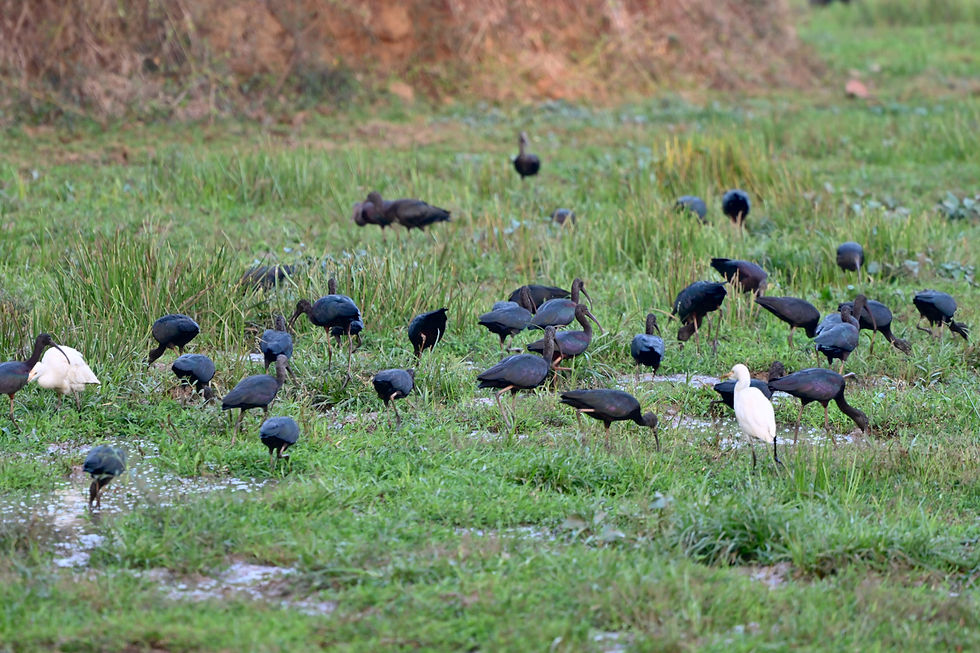
I wander off the campus into the village. Two houses away is an entire field sprinkled with glossy ibises and egrets and one lone painted stork. Further down, in a small river, a few men are harvesting clams.
A lady I had earlier seen talking to Mrs Bandodkar gives me a warm smile and asks if I’d like some tea.
I stop at her small shed, a tiny provisions store of candies and chips and knick-knacks. While the tea is being cooked, I watch with great envy the cat stretched languorously over the table.
Haven’t I done enough good in my life to deserve, even if only once a week, a respite from my insomnia, a few hours of feline slumber?
I walk back to the campus, greeting all village folk on the way. Some smile, some wish me back, a few shy away.
Kanik Lal ji, the chatty campus caretaker, informs me that Bhabhi ji has just arrived. “Breakfast in thirty minutes,” he says. Though his Hindi is quite chaste, he breaks into English whenever the matter is non-negotiable.
I walk back to my guesthouse, see a flight of stairs, and meander up to a large hall covered with corrugated sheets. The backyard is a small jungle.
My thoughts drift to the college course on narratives and self-esteem coming up next week. I need to prepare. I dig up on my phone extracts from Dan McAdam’s somewhat stodgy but highly enriching Stories We Live By: Personal Myths and the Making of the Self.
I pause at imago, ‘… an idealized concept of the self,’ and at the constructs of personal myths, and narrative redemption and contamination. None of this sticks to Mrs Bandodkar. She simply is, and she lets others be.
Something orangey slices my daze, peripherally to the left. I turn to see – it’s my flycatcher perched on a tree only a few feet from me. Finally!
I shower and get to breakfast on time. Mrs Bandodkar is finishing up a chutney to go with the aloo and poori. She’s all smiles.
I have never seen you angry, I tell her. Don’t you every get angry?
“I did feel anger twice,” she replies. “The first time was in 1976 when an old man in a position of power stole the credit from all of us. We had worked very hard, going door to door to collect funds.”
The second time?
She says that it was about a political injustice to village women, gets up and starts packing my tiffin. I secretly hope there’s chicken xacuti too, one of the few dishes that make me instantly shed my budding vegetarianism.
“Bharti ji never expects anything in return from others,” Mr Mani says. “Even at the age of 72-plus, there is no stopping her. She is still as energetic and enthusiastic as she was when she was younger.”
He hands me a large carton of Mankurad mangoes, the only variety that beats the Dudhiya malda from Digha.
I look at all that I am taking with me. I now have a bulging backpack, a full tiffin box, a carton, a camera full of images, and a head full of scribbles.
It really is a lot.






~*~