THE BENEVOLENT MOUNTAINS - I
Updated: Nov 26, 2025
June 2025


Just as you are done, you realise you have only just begun.
You have made your excursions deep into the forest, taken a thousand pictures, gazed at them with a smug smile, packed your bags, stepped out of your jungle lodge, and are headed to the car.
In those two minutes, even more insects and birds materialise. You are instantly overcome with exasperation. It's as if the wilderness is taunting you: 'Oh, you vain, weird little clothed creature, you had thought you had seen it all?'
You can almost hear it sneer.
Over a few more steps, exasperation yields to exuberance. You have seen nothing yet. You can come here again - and again!
The Sahayadris — ‘benevolent’ mountains — nurture close to a third of flora and fauna species found in India. One would need a lifetime or two to find and observe the bewildering varieties of trees, plants, birds, animals and insects that live here.
The Western Ghats, as this 1600-km mountain chain that's older than the Himalayas came to be called, hold in their embrace, like tolerant parents of variously inclined children, several diverse ecosystems: wet evergreen forests, montane grasslands, shola forests, moist deciduous forests, scrub jungles, myristica swamps, peat bogs and savannas.
There's much lyricism in biological nomenclature: shola, montane, myristica, savanna. They sound like titles of cult albums.
The Western Ghats watersheds feed major perennial rivers like the Godavari, Krishna, Kaveri and Tungabhadra, and countless rivulets, streamlet and waterfalls.
The mountain region is “recognized as one of the world’s eight ‘hottest hotspots’ of biological diversity”, says UNESCO on its website, under the heading ‘Outstanding Universal Value’.
It takes us only two and a half days to realise that.
All one needs is receptive headspace, forest-friendly attire, Buddha-like respect for all creatures, many of them so well-camouflaged you wouldn’t notice even when someone pointed them out, a wise guide, and a pair of binoculars.
To be very safe, in the event a leopard or bear comes charging, you also need a friend who runs slower than you do.


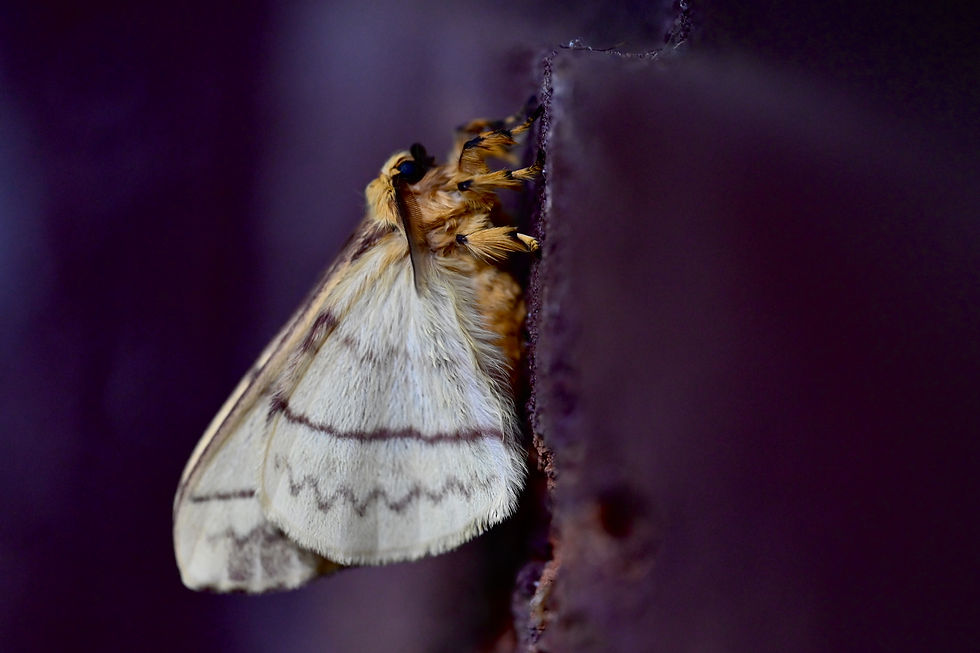




A Lot in a Little
These are some of the species we saw and/or heard over only two evenings and a morning - and while it was pouring most of the time:
Blue mormon, a butterfly the size of a hand
Rose-myrtle lappet moth
Black-tipped forest glory damselfly
Lesser fish eagle
Malabar gladeye bushbrown butterfly
Jousting subadult Indian bisons
Vernal hanging parrot/Indian lorikeet
Brown-cheeked fulvetta
Common Mormon butterfly
Malabar pied hornbill
Crimson marsh glider damselfly
Pill millepede
Indian green tortoise beetle
Poop-looking caterpillar of the Giant Swallowtail butterfly
Yellow-cheeked tit
Giant Malabar squirrel
White-rumped shama
White-rumped munia
Speckled blue and red planthopper/lanternfly
Red-banded leafhopper
Grey hornbill
Multicoloured grasshopper
Orange-striped lynx spider
Orange-headed thrush
Greater coucal
Southern hill myna
Minivet couple, orange and yellow
Dancing peacock
Spotted owlet
White-breasted woodpecker
Snails and slugs
Common kingfisher
Two jackals chasing one stray dog


The Not-So-Sapient Species
In the midst of such endless marvels, the grand munificence of these mountains, one pauses and wonders: What is it that makes us humans strut upon the planet so vainly?
Left unarmed in the wilderness, our rather unwisely labelled ‘sapient’ species would soon feel a crushing sense of nothingness and vulnerability - no protective or predatory wing, venom, poison, fang, talon, sting, gill, girth, horn.
We might ultimately be the wiliest and scariest of all species, we don't even look that scary. Unclothed, we look funny - and ashamed.
Did humans end up concocting weapons of mass destruction - plastic, pesticide, politics, profit, jungle resort, dam, missile - to overcompensate for this sense of utter impotence? Or was it to simply survive a wilderness that's well-armed and as brutal as it is beautiful and bountiful.
Whatever the intent of our transgressions, we can only hope that the Sahayadris, these benevolent mountains, will forgive us and will continue to share with us generously.


Sources: Artificial Intelligence and Real Experience
PS: Be advised, the author of this piece frequently and gleefully misidentifies species.
~*~