MERRILY LOST, MERRILY FOUND
Updated: Sep 25, 2025
May 2023

He could be a mystic in tan corduroy chinos and blue cap or a matador in tan corduroys and blue cap. We would know in a few seconds.
For all my wildlife bluster, I was not taking chances: this was a narrow one-lane part-metaled road flanked by marshy lands.
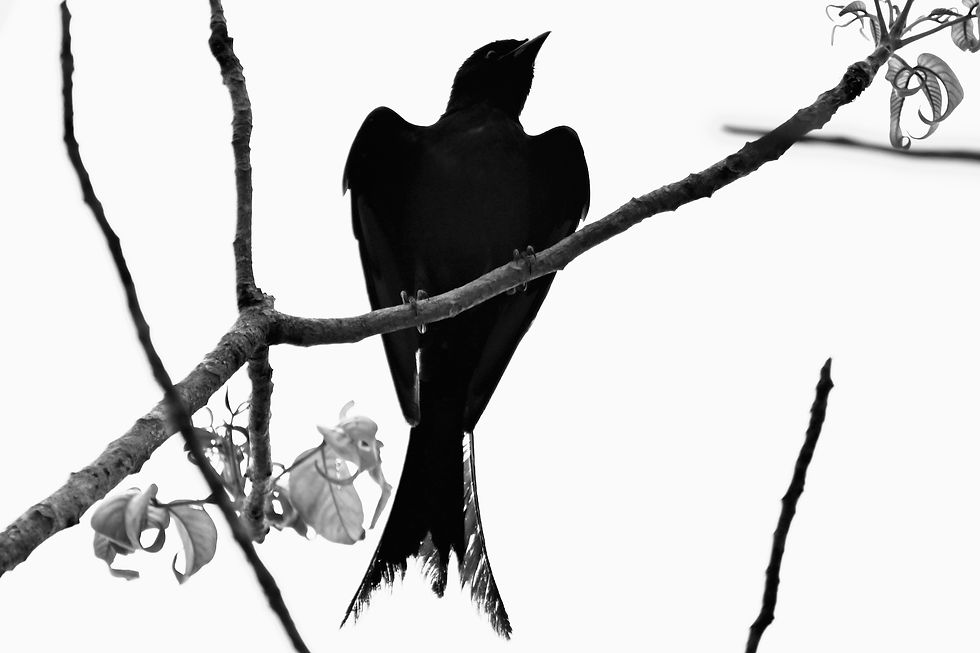
I had been looking up at a swallow perched on a cable when the wild water buffalo came at us in full gallop, backed by an entire herd, including two with endless pointy horns curving up behind their shoulders. They also had this unnerving gaze: heads lowered, eyes fixed on you, ruminating ambush strategy.
Their scientific name – Bubalus bubalis – was not comforting either. It sounds like Bahubali.
These might have been the same forbidding-looking family we had found wallowing in the mudholes a few minutes before. I had felt braver then – I was on higher ground and behind a wire mesh.
Not anymore.
This was level playing ground and there was no mesh. Being bumped off by a galloping buffalo was not a fetching thought. I’d end up becoming a posthumous joke. I went for spontaneous, alternative two-layered protection: I stood behind the car which was behind Joe.
Joe simply stood there in the middle of the lane as if he were waiting for his pet dog to come bounding when he returned home from work. Would he attempt to scoop up the buffalo like he had once scooped up a three-foot monitor lizard and a python off busy roads to relocate them in the wild?
The buffalo decelerated, gazed at Joe in bewilderment, and then stopped about four feet from him. Joe waved to the beast, asking it to turn back.
It actually did!
I had heard of horse whisperers and dog whisperers. But a buffalo whisperer?


Ibis Stopover
Last week I asked Joe, a Goan who has stayed Goan in the face of modern allurements, if he would show me some Goa that I hadn’t yet seen.
We painstakingly charted our trip over several conversations and set out in the morning with our water bottles and backpacks – only to not visit a single one of the predetermined stops.
We got lost and then decided to stay lost.
Paulo Coelho the spiritual fictionist once said, “We make a lot of detours, but we are always heading for the same destination.” It is obvious that Mr Coelho has never taken a road trip with Joe. Gwyn Thomas might have. He said, more wisely, “But the beauty is in the walking – we are betrayed by destinations.”
Not long after we set sail, we lost our way and realized that instead of heading into a lake, we were heading into an automobile factory. Once that fact dawned on us fully, we consulted the map. The rest, as they don’t say, is geography.
We drove past a slow-moving low-lying village and stopped first at Handi khuris, which means ‘feast of the cross near the sluice gate’. A lady sitting there under a tree gave me a big smile, I smiled back, and then she promptly sold me a bunch of candles for fifty rupees.
I said my prayers silently, one of which was to keep at bay the wild buffaloes, which had one by one begun emerging from the water, and got immersed in the kind of vistas that would inspire the Wordsworths and Shelleys of the world: lush green sprawls, happy cattle, hopping egrets, tall swaying trees, and gently shimmering water.
I felt like a bonafide poet-adventurer with a camera.
(It was only a little later, after the bounding-buffalo event, that my romantic imaginings were deflated with, “These are domestic animals, Amit. They are going home.”)
Reality can often be harsh.
Candles in hand, we drove out to somewhere, to suddenly stop at another majestic landscape: rolling hills, vast expanses of nothingness, blue skies, cottony clouds drifting languorously. (Some clichés are clichés for a reason: they are overused because they are irreplaceable.)
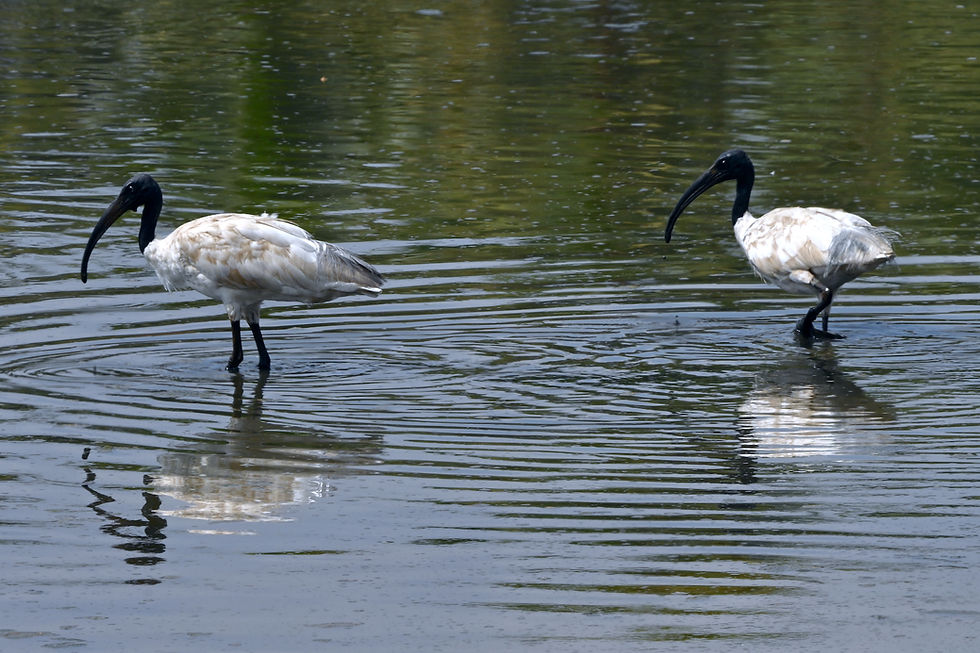
Minus my binoculars or telephoto lens, what I saw in the water down below were either old white people pottering around with black sticks, or a bunch of sheep, or restless punctuation – mostly the question mark.
Black-headed Oriental white ibises.
We parked for a few minutes to take pictures. A few looked up at us suspiciously, then considering us harmless – I am somewhat black and white myself – went back to their foraging, dipping their bills into the shallow water to skim for earthworms and insects.
It was almost an hour before I stopped, after sweating a couple of liters in that muggy menacing midday May sun.
And now I had, aside from the masterly buffalo whispering, one more reason to see Joe as my role model: while I was drenched, he looked dry as a leaf, happily scouring the horizons through the green field binoculars he had brought in his tiny backpack.


Lost Villages
As we drove on, I said: Someday perhaps one should visit Curdi.
I had heard about how a dam had displaced hundreds of villagers and that every May, when the water receded from the higher points of the reservoir, parts of village emerged: a temple, a cross, broken walls of some houses.
Why don’t we go now, Joe suggested.
We followed the map which took us off-roading through a jungle. For a long while there were no signposts of anywhere. Perhaps we were nowhere. Strangely, a comforting feeling.
Joe spotted some fallen jackfruit, we waited to see if anyone else wanted to claim them before we did.
Joe wrapped dry leaves around the top to prevent the milky sap from oozing into the car. With great enthusiasm I helped pick out leaves: this was my first handpicked forest produce. Four plum jackfruit – the word apparently derives from a Portuguese word which apparently derives from a Malayalam word – hauled into the boot, we continued our uncertain journey.
India has an amusing system of signage – there are none when you come to a fork. You pause, look hither-thither, find no one you can ask, raise your eyebrows, mutter a prayer, and simply choose a path.
Perhaps there is some deep eastern philosophy embedded in this system: Submit to chance, such is life.
We did, and within ten minutes were looking at the scattered remains of a village poking out of shallow lakes.
We paused to watch the yellow-billed river terns catching fish ‘on the wing.’ They would circle over the water for a while before dashing in. We then spent some time looking at dead tree stumps, a temple, and a lone dragonfly, possibly a blue dasher, braving a heady breeze.
There were no tourists here. The two cars parked in this mostly barren sprawl had left. This meant two things: no human chatter, and the freedom to pee behind any tree.
Under the white sun, this desolate landscape dotted with the dead tree stumps and salt marks felt like an otherworldly wasteland, almost apocalyptic.
I wanted to refuel before getting completely desiccated, so we decided to find a rest spot. We drove off Curdi, took a wrong turn, scraped brambles, managed to reverse, took another wrong turn, and eventually found our jackfruit trail.


Lost Mansions
The Goa which is still Goa and not yet Gurugram is a land of many things: river, sea, wetland, fish, feni, forest, crab, VP (village panchayat), temple, church, mosque, football, semi-clad tourist in hat taking selfies, coconut, kokum, cashew, susegaad and lost houses.
Some of the houses have been uninhabited – owners are overseas, or the ownership is obscure – for so long, they are overgrown with weed.
A few old houses have been turned into Portuguese showpieces for visitors, with guided tours all the way into vintage latrines. The prominent ones are easily found in every tourist brochure, every heritage-walk website. The Fernandes Heritage Home isn’t. One hope that it stays that way.
Though still thinking food, Joe and I are crossing Chandor – which was Chandrapura, the capital of the Kadamba dynasty – when we see a massive pinkish building with a small family emerging from it. We stop to take photos. A wiry middle-aged man springs up to us and says, “Wait here, I will be back in a minute.”
We don’t know who he is but we decide to wait by the entrance.
He returns, introduces himself as Ranjeev Fernandes, one of the fifth-generation owners “after conversion” of the mansion, and offers a tour. We ask how much he’d charge, and he says almost apologetically, “You can give me 150 rupees.”
He ushers us in, past the heavy palanquins and the dog slumbering on the floor.
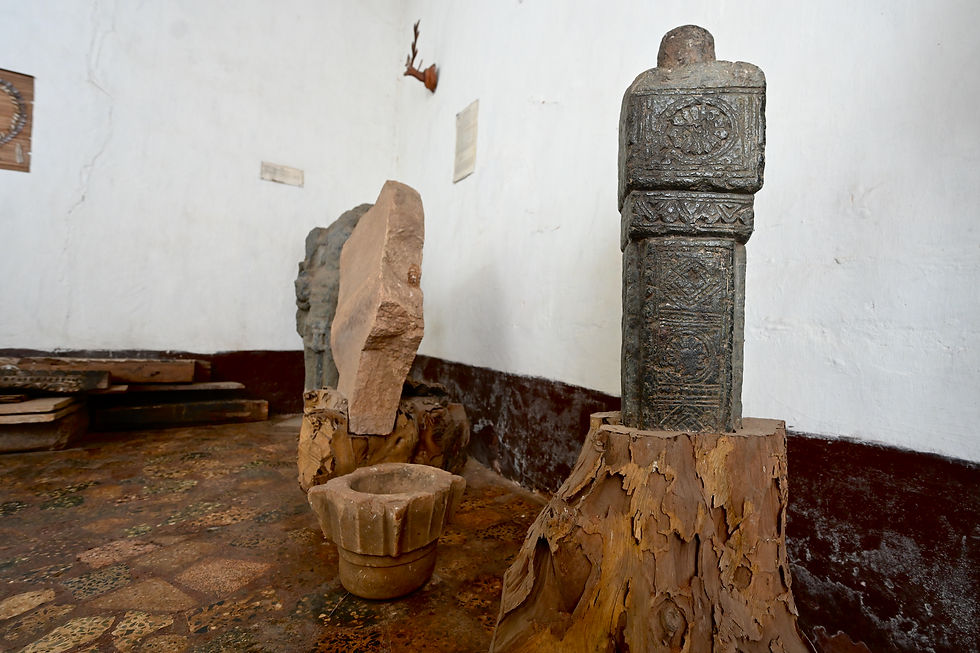
Ranjeev, we find out quickly, is disarmingly honest and hospitable. He points to some of the artifacts assorted near the entrance – piano, gramophone, utensils, rake – but when I ask him about the Spartan statuette, he grins and says, “No no, that is not so old.”
He leads us up the stairs to an imposing living room hung with elaborate chandeliers – a few of the bulbs still working – ornate old sofas with round seats, and above a grand piano a grand portrait painted in, the signature says, ‘23-12-12’.
“This is my great great-grandfather.”
I ask if I can take pictures. “Please do. There are no restrictions here.”
He then leads us to one of the bedrooms. I see in a corner a kidney-shaped bowl with a painting on the bottom. Unversed in the complicated history of ancient bathroom practices, I ask: “Is this is a toilet bowl? It is beautiful.”
Ranjeev laughs but with avuncular indulgence, so I get to feel that my question was born more out of innocence than ignorance.
“This is a baby bath.”
I get reminded that greyness of beard is not directly proportional to knowledge and wisdom. In fact, in these past few months of perpetual peregrination, I have come to discover that almost everyone I meet knows more than I do. My nodding and frowning with gravitas never hides this fact for too long.
I console myself with the thought that too much city, too much corporate, can do this to anyone – give you delusions of grandeur, flatulence of vocabulary.




Ranjeev proceeds to show us secret chambers in drawers, cavities concealed in furniture ornamentation.
There is a porcelain jug sitting on top of a tall and slim wooden cabinet. I am certain that this is an ancient, innovative water cooler but am wise enough to not venture any more guesses.
Instead, a safer: “What is this, Ranjeev?”
“This is a urinal.”
We follow him into another room where stands a wooden frame the size of a bed with curtains. Ranjeev tells us that this was a changing room for women.
Inside, he lifts a wooden panel on the floor to reveal a staircase that goes down to a basement where he shows us several holes in the walls. These were used to place guns and shoot. He also shows a chain that was used to measure land.
I forget to ask him who was shooting at whom and why, and what if the trapdoor gave away while someone was changing.
I can’t be blamed. Evolutionary glitches have made the human mind a monkey mind. After all, I am almost human too.
We climb back up and spend some time in the regal living room.
Oreo, a grey Lhasa Apso with a neat row of tiny white teeth, rolls up to me. I keep requesting him to stay put so I can take pictures of him in the foreground, but he prefers to amble up to first lick the camera lens and then my hands.
Ranjeev fetches us kokum sharbat and cake, some of which I share with Oreo. Ranjeev shows us the altar, his father’s collection of Catholic medallions and then hold up a teacup which has a geisha at the base.
He tells us that the house has more than 20 rooms and some parts are more than 500 years’ old. He has decided to “not do modern things like use cement and modern tiles and false ceiling.” The faded and chipped walls and furniture feel more real, unlike some historical buildings and artifacts that have been given a cosmetic makeover sometimes just to be more photogenic.
As we bid goodbye, Ranjeev gifts a bunch of homegrown bananas to Joe who gifts it to me.
Our famishment returns acutely. We stop briefly by the headless Nandi close to the Fernandes house, and then park at a roadside dhaba to have pao with kabuli xacuti.
Even before we have concluded our feast, I ask Joe: Shouldn’t we do this again?
After all, not every day does one find a fellow journeyman who helps you be both: merrily lost and merrily found.


~*~