LEAF LIFE - Part 2
Updated: May 27
May 2022
Weevil Weevil Rock You
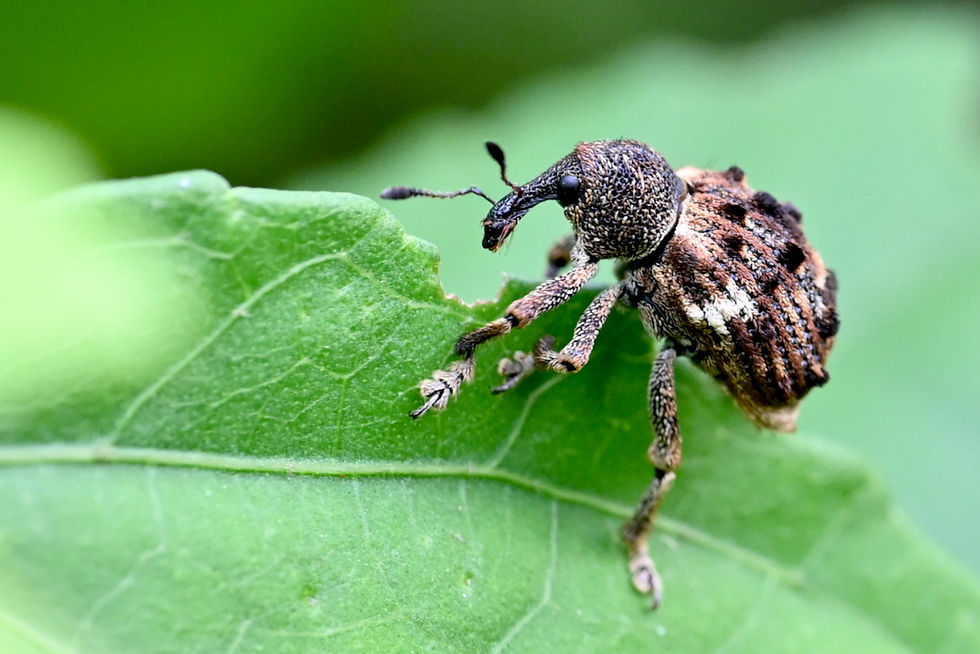
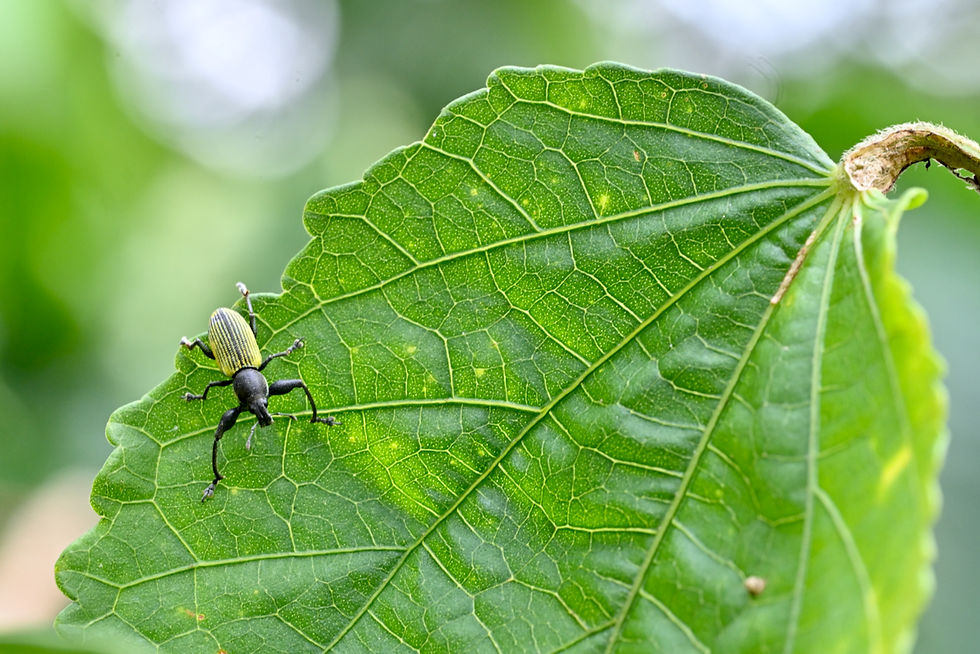
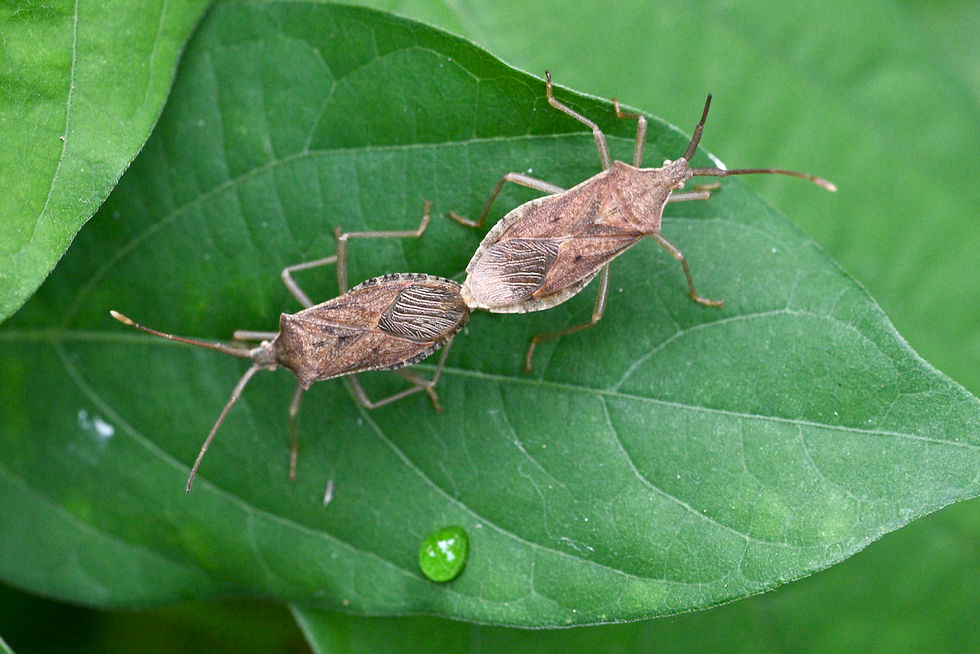
Then there were the weevils, which have snouts that make them look like miniature elephants. Since this is the season of pre-monsoon romance, they are often seen in a lingering embrace. If you, dear fellow mammal, feel a little envious of how long the weevil act can last, all you need to do is study the physics of copulation among some of these little creatures. You’ll likely be relieved you were born human.
I learned only recently about phenomena like retaliatory copulation and traumatic insemination.
This was rough on my sensibilities, but then my sensibilities are residually urban: far from nature, dense with needless vocabulary, soaked in senseless anxieties.
In other words, I am trying to move away from who I have been for many years. Moving on with the Coleoptera — which I keep reading as Cleopatra — even more dramatic than the weevils was the roundish beetle with its glittery orange body covered in a translucent cuticle. We had first thought it was a discarded part of a garish plastic toy.
When it flew, with three pairs of eyes following keenly, this tortoise beetle looked like a paraglider in neon attire. She might qualify as the Kim Kardashian of all beetles.
What we saw next could be the KK of all spiders. During one of our routines — crawling and looking under leaves — we saw a red globule surrounded by tens of tiny red pinheads: a mother spider with her babies. Google Lens says its scientific name is Theridula angula, also called the pearl spider.




A Taxonomical Muddle
On the subject of scientific names, I ventured only a little into that domain before doing an about turn. Here’s why.
There’s a fungus called botryotinia fuckeliana, a finch called poospiza hypochondria, a beetle called Ytu brutus.
Architectonica perspectiva is a sea snail which, in my view, does not offer a distinctively richer architectural perspective than many other snails.
There’s even Aha ha the wasp, and Vini vidivici the African parrot.
For some reason, unlike for astronomical bodies, the naming convention for creatures in biology is so open that you could get away with almost anything. You could even pay to name a discovery after you.
I am wondering if amitus nonstopum nonsensicus will carry enough gravitas for the flea I might just discover some day.
Multitasking as many mothers are, our theridula angula would watch over her babies, fend off red ants, and then go weave her web to catch food for her large and hungry family. We went there day after day, watching the spider babies grow quickly.
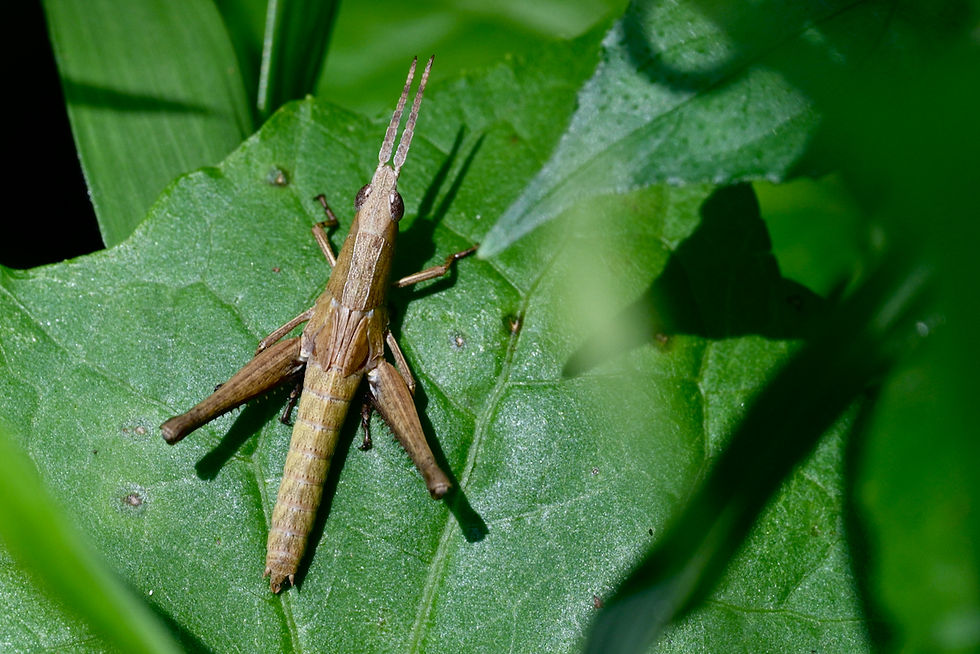
A few plants away was a strikingly blue spider which kept darting from under a leaf till it caught a little black beetle and dragged it into the shadows. Not anywhere as easy to spot were some grasshoppers and crickets. Their camouflage is so refined that they seem to be carved from the tree or plant they inhabit. The few exceptions were those with overlong antennae, many times the length of their bodies, and a tricolour specimen with yellow and green and orange legs.
All that craning and crawling meant two things: I came off with several spider photos and a crick in my neck. For the next two days, I prayed to nature — the only god I know — to organize her spectacles only to my left. She did.





The Omnipresent Omnipotent Fungi
Chhaata!
This is how my attention was drawn to them — my spotter associates’ unrestrained exclamation. Insect-spotting was abandoned for a while, and a new expedition was launched with renewed vigour.
Chhaata – Hindi for umbrella – were found on the ground and on rocks and trees. Just around us were all these mushrooms and toadstools: a snow-white bunch looking like an ornate upside-down chandelier, a caramel-coloured couple, and a bright yellow one standing in splendid solitude.
In these wet climes, fungi are everywhere, as they need to be if humans are to continue to survive.
Here are a few fascinating fungi facts:
~ They are the principal conservators of forests.
~ Over 90% of plants are dependent on mutualistic association with fungi — mycorrhizal symbiosis.
~ It is estimated that there are 3 million or more species of fungi.
~ A biologist who specialises in the study of fungi is called a mycologist.
~ Some mushrooms are toxic to humans, some are carnivorous.
~ The largest known single organism on our planet is the 'Humongous Fungus' in Oregon's Malheur National Forest; this subterranean honey mushroom spans roughly 2,385 acres.
~ Some fungi can turn insects into zombies, and can even spout from the insect's body.
~ Entangled Life: How fungi make our worlds, change our minds and shape our futures by biologist Merlin Sheldrake is an engaging book about the utterly dizzying world of this ubiquitous and versatile organism.
(Source: Wikipedia and other websites)



~*~