FARMER JOE
Updated: Sep 25, 2025
October 2022
The metalled road flows past stolid old houses and stylish new ones, shoots out an unpaved stump on the left, veers to the right, and carries on briskly.
Standing there at the fork, almost forbiddingly, is a plain black iron gate. This, unbeknownst to a passer-by, is a portal to an aberration, a divergent idiom of everyday life.

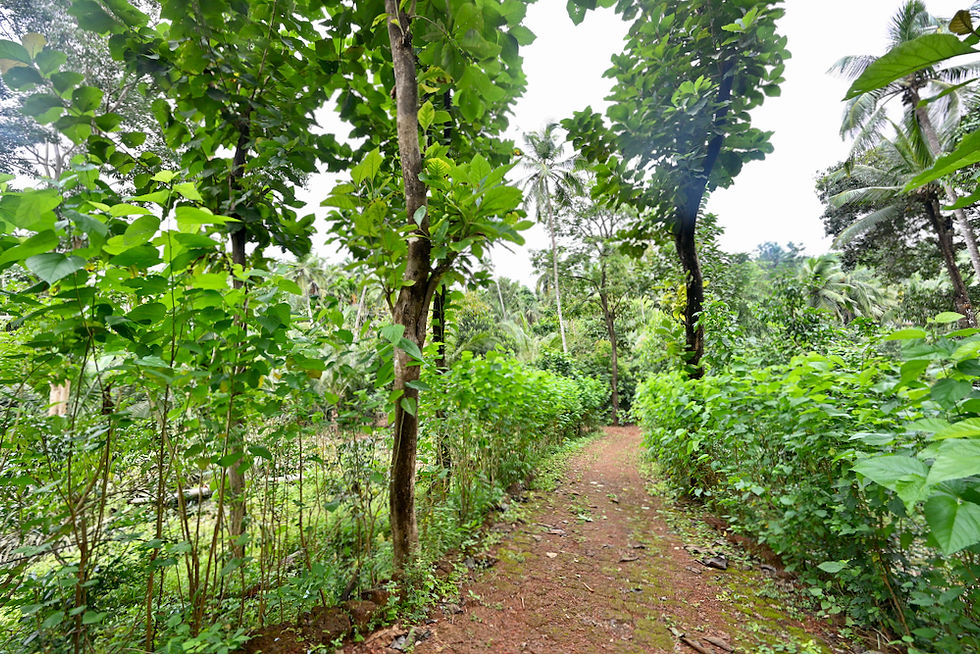


Joe gets down from the car, opens the padlock, and we drive down a gentle slope wedged between a row of trees. Suddenly but smoothly, we fall off the grid.
We park by a mud hut sitting at the centre of a backwoods farmstead astir with smells and sounds emanating from all directions.
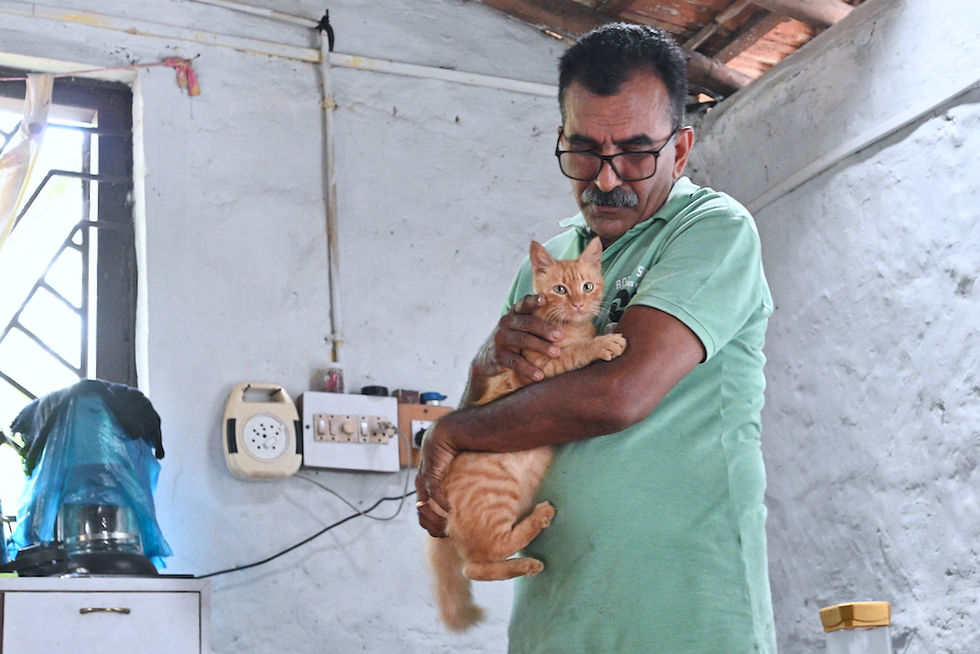
Brownie is yawping, Champa chomping, Mr Brown and harem clucking, an unnamed yellow kitten purring half asleep. All are seeking Joe’s attention, only the kitten with an aristocratic sense of entitlement.
There’s Ghamshyam of Chhattisgarh scraping and digging, his wife Rijubai plucking and weeding. They live here with their daughter Alpana and her son. Then there are three temp workers from West Bengal pruning a tree. One sits astride a branch waving his glistening machete at me in greeting.
I’d like him to stay there at that altitude.
At the centre of this ensemble is Goa’s very own Joe. On the side is an unanchored me.
I feel I have entered a large amphitheatre which contains many tiny ones, each playing out a spontaneous script written in collaboration and competition by a million authors.


Interspecies Introductions
I toddle behind Joe as he shows me around. He feeds Mr Brown from his palm. I try too but the cockerel is suspicious. I step back and focus on its tawny feathers and crimson comb and wattle. Regal.
Brownie is much more welcoming, trying to rip off my trousers with his claws while wagging his tail vigorously.
Champa too, though she might be just swishing away flies. Joe fetches her fresh grass. In return she butts him repeatedly. I am new to bovine customs but this might be a novel way to show gratitude. This looks so much fun, I think I am going to try it someday on a fellow mammal.
I gaze into Champa’s eyes, hoping this wouldn’t be interpreted as an amorous advance – there is romantic poetry, all moist, if you look deep enough into a cow’s eyes. I think of that cultic paper by Thomas Nagel: What is it like to be a bat?
Or a cow?
There are swatches of many different plants and trees on the way: an appliqué of abundance. Of the 221 species he grows, each of which he can identify readily, I only know coconut, okra, corn, lime, mango, red chilli, turmeric and sindoor.
At the rearmost edge of the farm is a canal of murmuring spring water. On either side coconut trees shoot off into the sky, their looming shadows swaying in the stream spangled with sunlight.
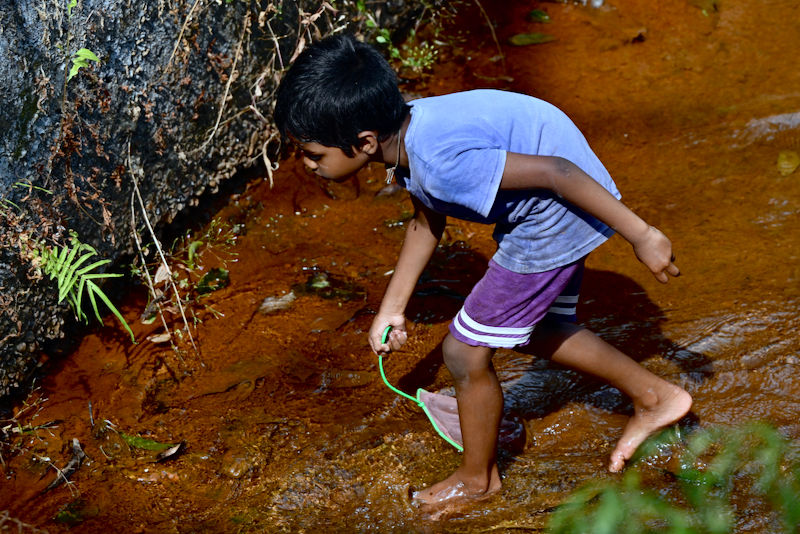
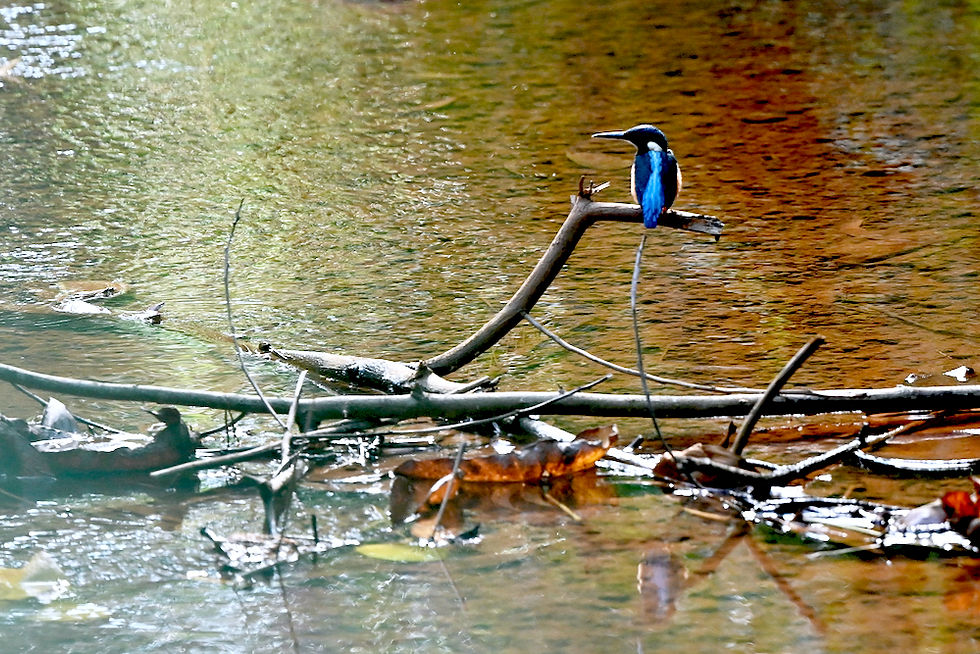
A kingfisher couple sits on a branch that has fallen into water. They look satiated, idly contemplating the next feast – the water is stippled with the local guppy. Little do the kingfishers know that Ghanshyam too is contemplating this feast for dinner, getting his net ready. The stream hesitates where the rocks are large. More fish gather in that pool.
A cormorant basks in the plentiful midday sun.
Time here is untameable – it comes and goes as it pleases. There's just this sense of stirring, a continuum.
The bigger kingfisher turns, studies my intrusion for a few moments, and flies off further downstream. The smaller one follows. Some birds are gabbling in the treetops.
Joe leads me down the spring to his well and several waterholes, one of which is sparkling with dragonflies. I see a red mating with a yellow – possibly a crimson-tailed marsh hawk. I hunker down, creeping closer.
When I’m done, which I never am, there’s no Joe in sight.
I find him in his solarium, a mud hut with big windows, skylights and rugged walls. The attached bathroom has a fluttering curtain for a door. The shower is an open space behind the hut.
The room is a patchwork of tidy spaces minding their own business: bed, chair, table with fresh fruits and gooseberry and starfruit pickled in brine, basic implements to rustle up tea, a refrigerator, a long horn.
The kitten is curled up in a cane chair. I envy her.
In the department of sleep, I am somewhere between equine and feline, close to bovine.




Up the Hill
Joe hands me the jars of pickle and a tender coconut with a castor straw. I need the recuperation. This geography is as muggy as it is lush.
I ask him what that horn-like thing is. He blows out a guttural note, reassures the startled kitten that all is well with the world, and bounces off for round two of the guided tour. He is unputdownable.
First the untended uphill tract.
He climbs up the mossy stones like a mountain goat, I keep skidding like a regular human. He has left that patch of wilderness be – a tiny forest of veteran trees. In the middle sits the cashew.
Feni might not be too far.
Something scampers through the undergrowth. This is a world of deep camouflage where a creature can make itself invisible in plain sight. I am reminded of the photo Joe had shown of him holding a cobra, taking it to a safer place. I wish I had been there.
We climb down, he shows me the hammock he has put between avocados, and then we zig-zag through various flora.
‘Taste this,’ he says, ‘and tell me what it is,’ as he plucks a succulent leaf. My senses explode with glacial gusts. I live out one of those transcendental cinematic moments: nose tipped at the horizon, arms stretched, at the edge of ecstasy, Titanic-type.
Spearmint is far more arousing than caffeine.
‘Taste this,’ he says, ‘and tell me what it is,’ as he plucks a leaf from another plant.
Clove.
There’s no pausing Joe. The plant quiz continues. After a great initial score, my horticultural aggregate starts to dip, and my curiosity rises. I have so much more to know, to chew on.
I am on an olfactory high. My senses stirred, I am also famished.
We roll off on his scooter for a Goan lunch of sukya sungtachi kismoor – dry prawns the size of oversized ants – and mackerel fry with rice. We sit in an unassuming Goan dhaba. In my zeal, I also order chicken cafreal.
If it weren’t for the sunshower – it is often that there’s light rain while the sun is shining - I might have snoozed on the scooter on the way back to the farm. The afternoon has turned clammy, as it often does in these parts where sea and forest and river and wetland converse in damp whispers.
Joe asks if I’d like to take a nap, I say no out of courtesy and a misplaced sense of youth. Secretly, I hope that the world would be engulfed in a susegad haze.
Nothing of the sort happens. The day thrums along. Only the kitten and I are yawny. She makes a show of it, I stifle.



The Farmacy
I tell Joe I’d like to know more about his farm.
He leads me out, bringing along lemonade made from freshly plucked Italian lime. Outside, the dog is catnapping and the cockerel has found a shade to potter about, occasionally giving his small harem a withering glance (it’s not always the male; I recommend Bitch, Lucy Cooke’s revealing book ‘on the female of the species’).
Rijubai is winnowing rice, Nitish still in his school uniform looking at a book of birds, Ghanshyam carrying a shovel somewhere.
When Alpana’s husband had found out that she was epileptic, he had abandoned her. Joe took them in and put Nitish in school.
Joe and I wind up in the gazebo, surrounded by grass growing lustily. Some of it is vetiver, he tells me.
I ask him, a career academic, how it all began.
Twelve years ago, 30 years into his teaching profession, Joe decided to walk away one day, turning his avocation into a vocation.
I wonder why many of us become careerists and not much else, relentlessly wishing we were elsewhere.
‘I always loved to dirty my hands in soil. I used to have a small garden patch.’ He tells me about the comunidade system where land belonged to a community. That system is now mostly nostalgia.
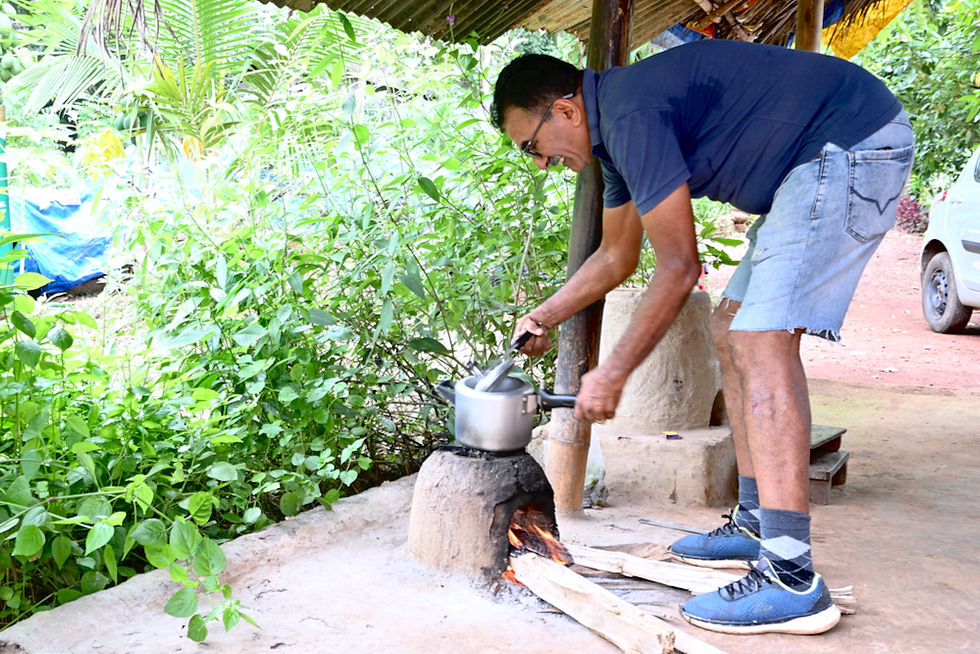
Part family man, part bohemian – muddied sneakers, faded shorts – Joe spends the day in his creek-side farm where he is a sort of frontiersman living on the threshold of the settled and unsettled, the gentrified and rustic.
On Saturdays, farm yields to field. He is punctual about his weekend hockey game.
I resonate with his less cultivated, carefree side.
When he started off, it took him three years just to make the road. ‘I had to build a toe-wall at the very base of the hill. I had to keep pitching the mud.’
It took another few years to turn the wilderness into a farmstead with the 221 species of plants – floristic diversity to which he keeps adding a patch here, a patch there – on this verdant biodiverse acre sitting in a valley full of natural springs.
How Green Was My Valley.
Richard Llewellyn would agree: this green.
I feel like an ecological refugee in a bygone place far from a future that is coming at us with fury.
Joe opens his diary where he has made lists in pencil. ‘I have categorised the plants as medicinal, wild, spices, fruit-bearing, veggies. I have all the 58 mentioned in a book on medicinal plants of Goa.’
I pick up a few names from his lists: Asafoetida, arrowroot, noni, soursop, paradise plant, turmeric, five types of spinach, gooseberry, pepper, ginger. He mentions the healing properties of some of them.
This is like a herbal compendium, I say.
‘Farmacy’, he chortles, his eyes crinkling.
I pick a few more: Kokum, cashew, mangosteen, mango, dragon fruit, avocado, custard apple, love apple, velvet apple, zapota, fig.
All that apple brings to mind a recent favourite on my bookshelf, The Botany of Desire, and the nurseryman Johnny Appleseed.
So, do you also sell?
‘Not really. I did get 42 kilos of wet ginger this year and I sold some of it. I get about a thousand coconuts a year but that is difficult to sell.’
Commerce is cumbersome. The world might have done better to retain the barter system.
At the Bhogali Bihu by the Jonbeel wetlands in Assam, the Tiwa community still practices the binimoy protha (exchange tradition) every year.
‘It’s a simple credo, bro,’ my friend Pranab Bora – poet, musician, encyclopaedia of the Northeast – explains.
‘In place of this, I give you that.'


Organic Surprises
Any life lessons that you have learned over the years?
‘Recently I paid a substantial amount for cow dung. I didn’t know that I bought with it the dung beetle. You can never be completely in control.’
Joe’s no idyllist. He leaves the romanticising of the countryside to us city folks.
He had earlier shown me a red palm weevil burrowing into a knothole. This strikingly patterned snout beetle can quickly turn a tree hollow.
It is not easy to outfox insects, especially if you reject toxic chemicals. Joe practices JADAM, the Korean philosophy which prescribes a fertilizer made of natural elements.
‘Ferment over six days, use it within 3-4 days. I am on my 60th barrel,’ he says while dipping his hands in a blue drum up to the brim with a foggy white liquid.
He stirs it with the kind of gladness that promises sweet inebriation.
‘Smell it.’
I do.
I shouldn’t have.
In that one moment I postpone my commitment to becoming a farmer. It is evident that farming will not entirely be an aesthetic indulgence.
The JADAM fertilizer, to give you a sense of what I inhaled, is a concoction of starch, cow urine and cow dung – fermented in tropical heat. His other fertilizer is fermented raw fish waste, the kind that gets discarded in fish markets.
Biotic farming is symbiotic (whoever coined the term ‘antibiotic’ either didn’t care for semantics or didn’t have much love for nature). There’s near-zero waste, if any.



Are there any other persistent challenges that he faces?
‘Reproducing plants is not easy. It is difficult to get organic seeds, and difficult to get labour. Also, you can do all you can, but you can never be sure of what the harvest will be like.’
Every farmer knows: the future is never foretold. You defer to nature’s many moods. You find that delicate balance between deep respect and healthy detachment – perhaps in all relationships.
You even defer to that disconcerting possibility: What if there is no single integrated entity we call Nature? What if there are simply all these inscrutable energies that collide randomly?
Within this confounding fluidity, we perpetually seek equilibrium.
I am lost in thought when Joe springs from his chair – unlike me, he is not given to idling or chatter – and asks me to follow.
He shows me the big well, the natural stream that flows by, and how he bunds the water to keep the water table high and create waterways.
‘You want a pedicure?’ he asks, pointing to the guppies in one pond. ‘Imagine your feet dangling in water, you reading a book and sipping homemade lemonade, getting a pedicure.’
He then shows me the wood-fired pizza oven he has built, a tapasya point under a tree, a discourse point, and the plunge pool.
‘I am still working on the biogas plant.’
He plans to offer select visitors countrified experiences: Swing from a fig tree, plunge in a waterhole, lie in avocado hammocks, sleep in straw huts, use ancestral-style restrooms, shower in the open, have a foraged meal, make your own squashes, learn grafting, prepare water-retention rings, make your own compost, design pumps without motors.
I am about to offer some ideas when I hear a patter of hooves. Champa is trotting towards me. I jump into the bushes. She glances at me with disappointment, at my lack of gallantry and chivalry.
I am not yet quite ready to be butted in my behind by a cow – that too a cow in full gallop – regardless of her feelings for me.
‘She likes to run around for a while before she settles to be milked,’ Ghanshyam tells me.
This is gōdhūli bela, an evocative Hindi phrase for that time of the day when cows raise dust, herald dusk, as they head back home.
‘Shall we?’ Joe asks.
Wrapping up for the day entails a ritual. The three litres of milk Champa gives him every evening are poured into three bottles: One is for Nitish, one he takes home.
As we are about to leave, Aplana asks, ‘Will you come tomorrow also?’
Joe, in jest, says: ‘He will stay here now.’
I hesitate to tell him that I am already making a list of things I need to pack.
We set off in his car, up the slope, back onto the metalled road, past the old houses and new, merging into the collective hysteria of the highway.
In a few minutes, without warning, Joe stops by the median. Unmindful of the honking, swerving cars, he waves to someone across the highway, gets off, leaves a bottle on the median strip, and drives on.
This is how every evening he delivers the third bottle of milk. It is for children living in a roadside shelter.


A Sand County Almanac
I made the delightful mistake of reading A Sand County Almanac before writing about Joe.
Aldo Leopold, a distinguished voice in the discourse on ethical environmentalism, wrote lines that I imagine I did (he died about two decades before I was born).
I have had to shake my head to separate inspiration from plagiarism. Ultimately, in all fairness, I thought it would be best to simply present some extracts from the Almanac.
“There are two spiritual dangers in not owning a farm. One is the danger of supposing that breakfast comes from the grocery, and the other that heat comes from the furnace.
“ … eyes turn cityward rather than landward.
“They live on the land, but not by the land.
“That whimsical fellow called Evolution …
“Solitude, the one natural resource … is so far recognized as valuable only by ornithologists and cranes.
“But all conservation of wildness is self-defeating, for to cherish we must see and fondle, and when enough have seen and fondled, there is no wilderness left to cherish.
“The water must be confused by so much advice … Hence we have dustbowls, and rivers washing the future into the sea.
“We all strive for safety, prosperity, comfort, long life, and dullness … but too much safety seems to yield only danger in the long run.
“Your true modern is separated from the land by many middlemen, and by innumerable physical gadgets … to him it is the space between cities on which crops grow.
“I am glad I shall never be young without wild country to be young in. Of what avail are forty freedoms without a blank spot on the map?
~*~