MARVELLOUS CREATURES
Updated: Aug 9
August 2026



We glide past the gate with such absent-minded ease, we forget that we are trespassing.
We look around, find no barking human or canine, and we arrange ourselves and the tripod next to the parked cars and point the lens upwards.
There is perhaps a little ruffle of a curtain, possibly the house owners peering out of the window, but we would answer to that later. So far, all our intrusions into other people’s properties have concluded in a friendly exchange, often with their dogs too. We hope it would be the same this time.
For now, our attention is on the thousands of utterly curious creatures — human plus dog plus bird — squealing and screeching above our heads. All the trees around us are laden with them, like some large orange-black overripe fruits.
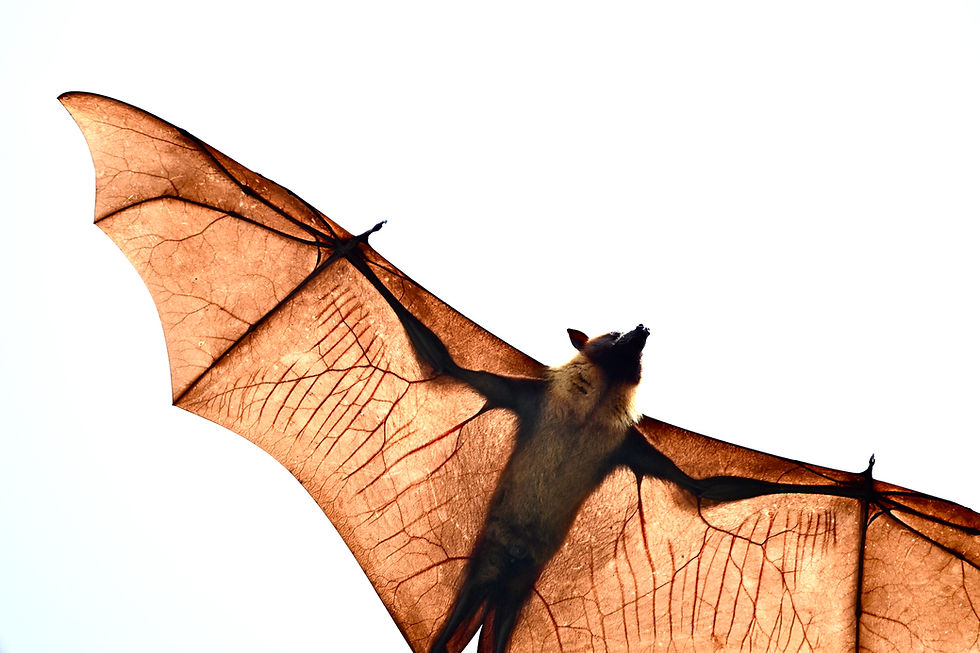
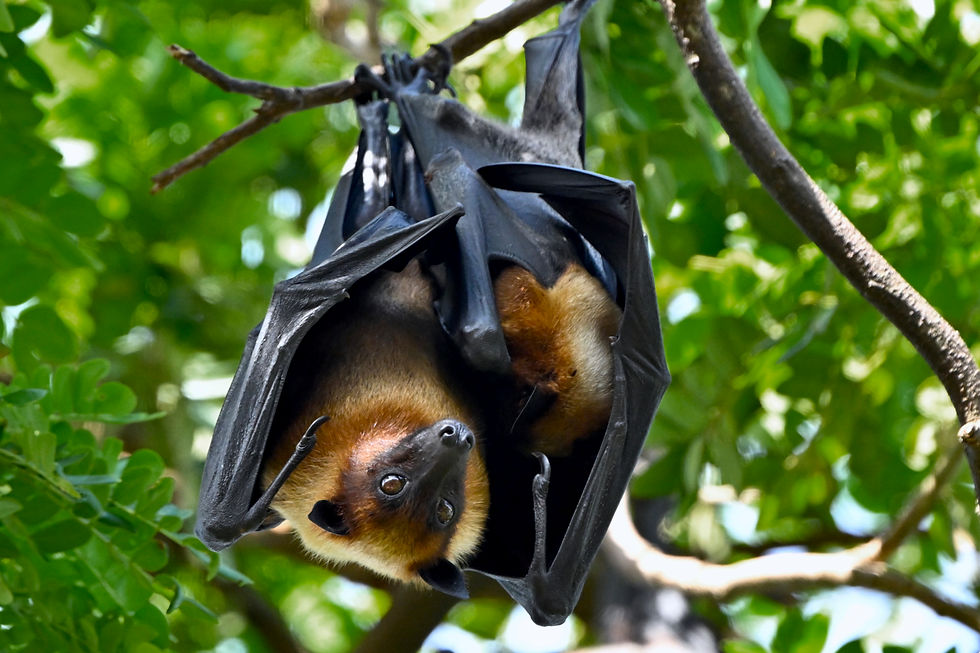
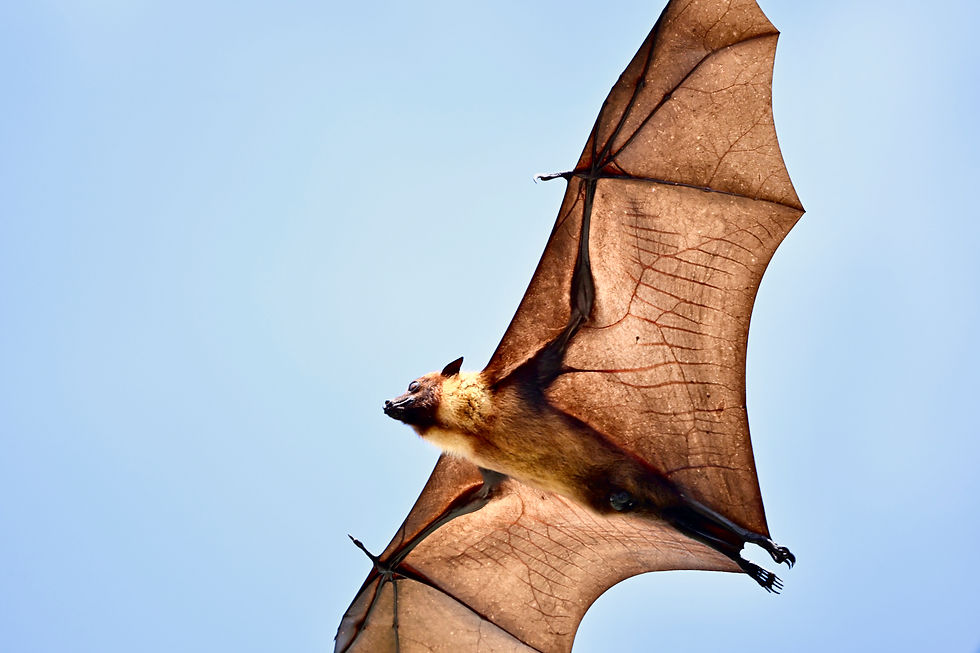
This is the largest congregation I have seen yet of the Indian flying fox, also known as the greater Indian fruit bat.
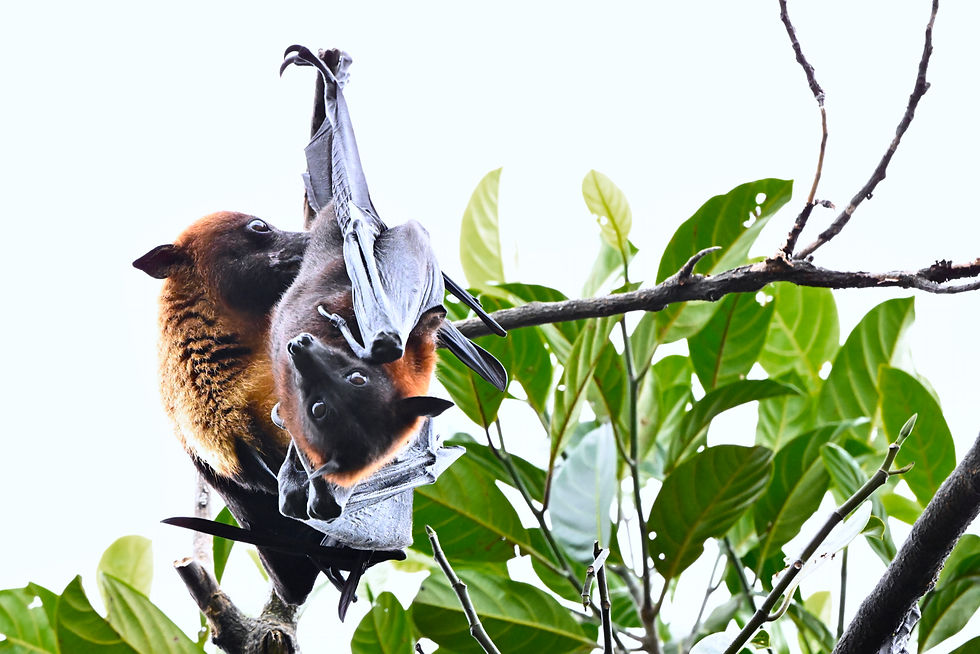
They are hanging upside down, their sharp claws clasping a branch or trunk. Some are looking down at us inquisitively with their shiny amber eyes (yes, bats can see), some are wrapped like a cocoon, a few are fanning themselves with their membranous wings, two are twisting and tangling in a mating frenzy, and one male is persistently seeking that experience. His female neighbour does not seem to be in the mood but when he sulks away, she pokes him.
We wonder how the concept of consent works in the wilderness and if, like in humans, amorous engagements can often be ambiguous and ambivalent.
There is one unusually bulbous bundle from which two faces peer out: mother and pup. The little one, which is not so little, wants to suckle but the mother seems to have had enough. She keeps trying to coax it away. After a few minutes of scolding and nudging, the mother wraps the pup back into her wings and they doze off.
Up there in these trees this muggy mid-monsoon afternoon, life is happening at varying degrees of arousal — procreating, nurturing, resting, squabbling, preening, observing.


A COUPLE OF SURPRISES
A lady steps out of her door and looks at us. Before she can say anything, we apologise profusely for the intrusion, explain that we are here for the bats, and start packing up. She hurries in and emerges with a man who asks rapid-fire questions: name, occupation, residence, purpose of visit, social media presence.
He stops at the ‘professor’ word, smiles gently, tells us about his experience with the bats, points to all the droppings, and asks us to stay. They both go in and get us a homemade amla-jaggery drink. It is so refreshing in this cloying mugginess, I ask for more. They tell us when the bats are most active and ask us to come back anytime we want.
We go back the very next morning.
No trespassers anymore, we drive up to our new friends’ house, set up our gear, and look up, our mouths shut tight, for specific shots: bats flying, landing, instantly turning upside down, squeezing into tight spaces, crawling along branches, brawling with neighbours, licking their wings, and even yawning.
The couple calls us in for breakfast of that distinctive Maharashtrian poha and ginger tea. This excursion is turning out into a picnic. What we offer in return are some bat facts that we have recently discovered. We highlight the striking similarities with humans.
Bats have ten fingers, including thumbs; their wing bones match human arm, wrist, and fingers — humerus, radius, and phalanges.
They have warm-blooded bodies covered in hair and use both sides of the brain to process sounds.
Most of the 1400 bat species are social and live in colonies.
Bracken Cave Preserve in Texas hosts 15 to 20 million Mexican free-tailed bats, making it the largest known concentration of mammals on earth.
Flying fox pups cling to their mothers when they fly for food; once the pup gets too heavy to carry, they are left in crèches.
Bats are the only mammals capable of ‘true flight’.
‘No bats, no chocolate’ might very well be true: over 500 species of plants depend on bats for pollination and seed dispersal, including cacao, bananas, and mangoes.
Biotech companies are studying bats for their genetic immunity and response to inflammation.





LALBAGCHA RAJA
The next time we are in the area, we seek a different vantage point. Driving along the bat trees, we turn into a back alley and soon reach a dead-end.
An old man, his wrists gnarled and bulging with burls, possibly from gout, is sweeping the area around his hut. He looks up. We tell him why we are here and he points to a spot from where we can get an unhindered view.
The bats are indeed closer from here but now we also have another congregation to deal with: a large pack of dogs.
Even as we attempt to make peace with the pack, an auto with ‘Lalbagcha Raja’ emblazoned on the front glass pane drives in and all the dogs — about 20 of them — run to greet the gentleman who steps out. They seem to have been waiting for him.
“Don’t worry about my dogs, they won’t bother you.”
Your dogs? All of them?
Raja, as he likes to be called, says he provided shelter to a couple of street dogs a few years ago and gradually the numbers grew. He cooks for them, bathes them, vaccinates them.
Is he part of an NGO? How does he manage all this?
He tells us that he used to be a choreographer in Mumbai. “I could be on stage non-stop for three hours … Bhairav, Bhairav … Blackie … Barkya …” Raja acknowledges some his more demonstrative wards in between giving us a clipped description of his life.
He now lives in Sawantwadi and drives an autorickshaw for a living. “I don’t have an NGO, I am able to take care of them by myself.”
He makes it sound simple and easy.
In a corner of the patch of land he has under the bat trees is a tiny tin shed packed with broken plastic chairs, tables and a stove where he cooks rice and chicken in large vessels. On one shelf are the big ledgers where he keeps documenting the vaccination dates for all the dogs, most of whom are currently occupying every inch of furniture and floor.
Bhairav and Ganpat are still out there in the open chasing each other or head-butting me whenever I try to take pictures of the bats. In close-ups, the bats look like dogs, specially when they show their long pink tongues.
On a whim, we ask Raja if he would show us around on his auto. He asks us to hop in right away and off we go. The auto takes off like a rocket, swerves at curves, flashes ridiculously close past incoming cars, kicks off gravel. All through this rather filmy ride — this is Mumbai’s Lalbagcha Raja after all — we are flanked by the breathtaking lushness of the Western Ghats.
Within two hours and a half we have bowed at a Shiva temple that was constructed overnight by village volunteers, had steaming samosas at Santosh Naik’s Sri Ganesh Samosa Vadapav Centre, listened to Malvani songs from Mr Parkar, a 70-year-old poet and theatre artist, taken a tour of a kaju factory, and paused to watch a lean old man in a tattered shirt ploughing his bulls through sludge.
“Come, you can also try this,” he says with a grin. He too makes it sound simple and easy.
Before we head back to the bats and the dogs, and then back home, we spend some silent moments on a bridge across Terekhol river at the foothills of the Sahayadris — the benevolent mountains.
We ask Raja how much time we have. “Take all the time you want."
Not too far from the madding urban crowd, out here in this vast wilderness in a world not consumed by phone and internet, we are immersed in a sense of deep gratitude for all that we have been given so freely, so readily.
Given even that most precious of all things — time.
~*~