A DEEPER RED
June 2023 (Photography), July 2024 (Essay)


Baba and His Bahadur
Bahadur is a colourful picture of imperturbable equanimity.
He doesn’t flinch when amber liquid is poured on his bare vermilion-smeared head, or when a marigold is stuffed in his nose.
Bahadur transcended the temporal a long time ago. Lal Baba is in the process of transcending. Both soaked in red, both emanating a sense of the invulnerable beyond, they are comrades that hover on either side of life’s threshold.
The three of us are sitting on the floor next to a burning pyre at Bhootnath Mahashamshaan Kali Mukt Dham, a space that Lal Baba commands during the annual five-day Ambubachi Mela at the Kamakhya temple.
When he strode barefoot — he’s always barefoot — into this famous cremation ground, people parted in nervous reverence. No one wanted to cross his path.
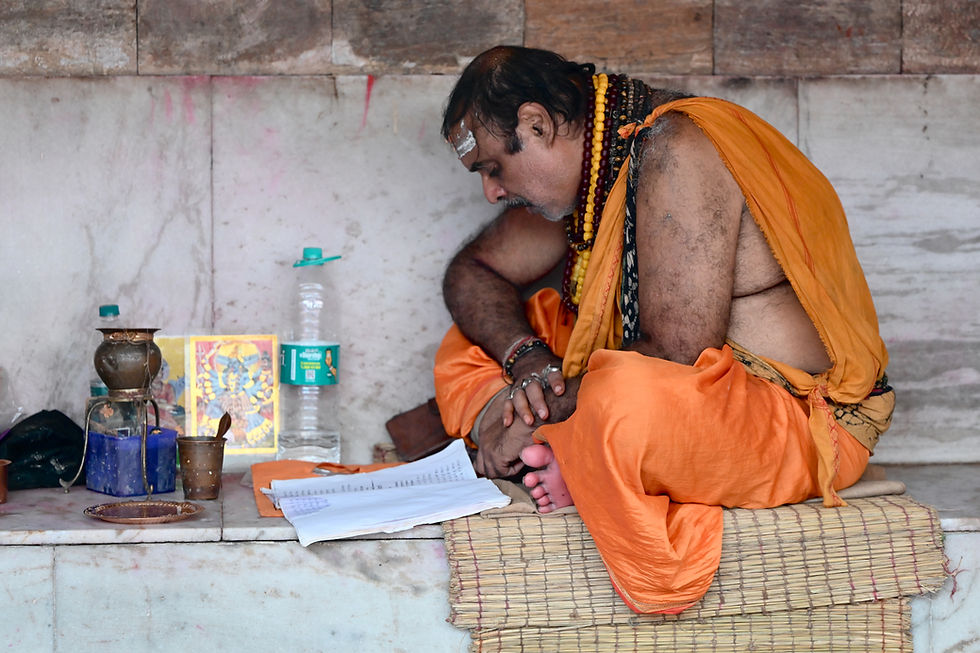
Lal Baba is a prominent Aghori, his aura enhanced by his lanky six-foot frame, flaming eyes, airy gait, long black hair and thick black beard, lungi and gamosa and turban — all red — and several jangling malas, some made of rudraksh and two that are a string of miniature skulls carved out of bone.
Once he occupies his corner, the chandals, a caste which has historically been relegated to the disposal of corpses, and other tantriks mill around him, bow, and ask, “Baba, adesh?”
They are desperate to do his bidding. I envy him. No one ever has been keen — forget desperate — to do my bidding.
Lal Baba gives his instructions, puts down his bag, sits cross-legged, gently unwraps a red cloth, picks up the skull — that’s Bahadur — and pours alcohol on him before taking a few gulps himself.
He then places the yellow flower in Bahadur's nose. shuts his eyes, and commences what he calls his sadhana.



Spoken with Water
A crimson river flows upstream, swelling and surging like the Brahmaputra.
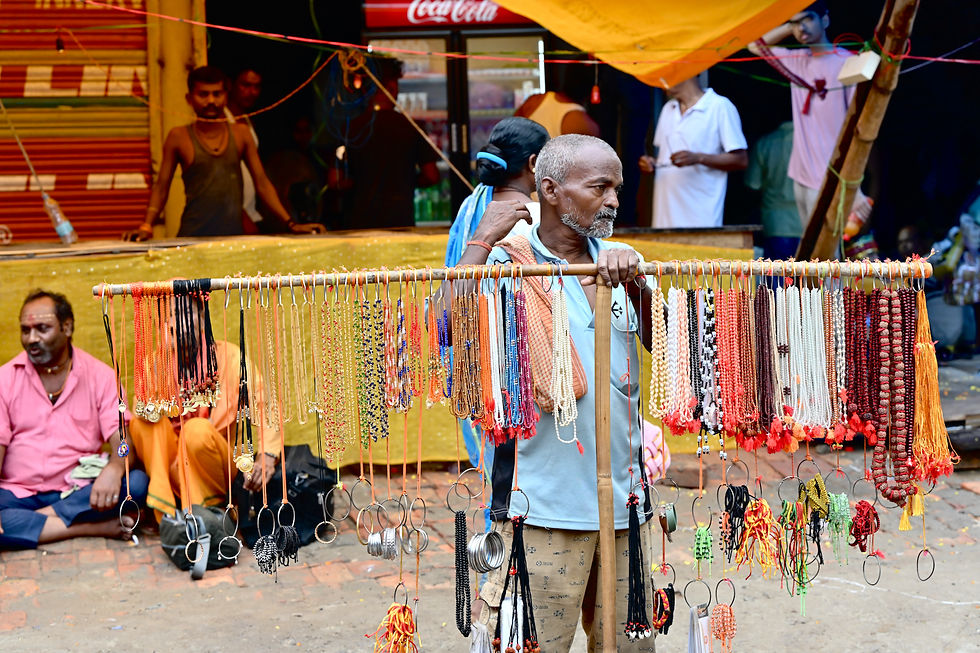
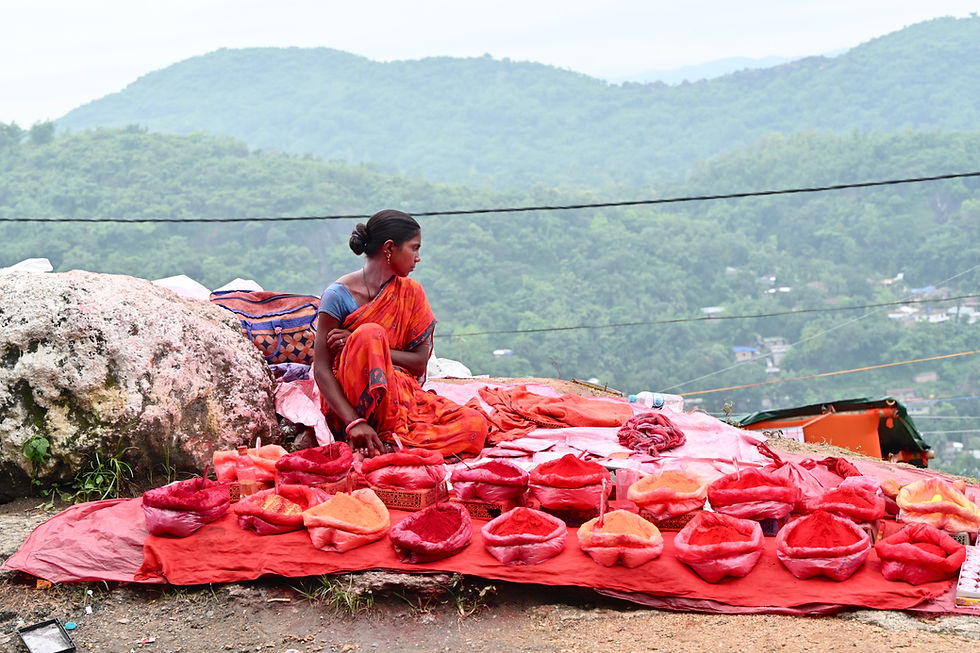
Drenched in monsoon mugginess, clothes clinging to skin, reddened sweat trickling down foreheads, men and women, sadhus and civilians, many with vermilion or ash or chandan on their foreheads, are trudging the three kilometres to the top of the Nilachal — ‘immovable blue’ — Hills.
There, in a rock cave, in womblike wetness, in womblike darkness, sits Kamakhya, the Goddess of Desire.
Every June, during the Ambubachi Mela, hundreds of thousands of devotees converge at the temple complex to celebrate the annual menstruation of the goddess. The sanctum sanctorum stays shut.
'Spoken with water', that’s what Ambubachi literally means.
A middle-aged woman, tote bag on head, has come by herself all the way from Burdwan. She says that she comes simply because she must.
A young woman glances at us and breaks into spirited chants of Har Har Mahadev, playing her damru.
A man in his 40s dressed only in a loin cloth and a thick coat of vermilion head to toe, poses for the camera. He stick his tongue out and does a tandav act, his potbelly jiggling with abandon.
Faith can make one obliged to feel and exhibit excessive emotion.
Another draws attention with piercing notes from his mohor xingor pepa, a bugle made from buffalo horn.
Every few steps, huddled by the side, lie clumps of hazy-eyed dreadlocked sadhus lost in their own stupor. One offers me a drag from his chillum.
Entangled in this ceaseless exhibition of devotion, which ranges from stoned silence to muffled chants to rhapsodic bursts, is the spectacle of poverty: wobbly pushcarts, swathes of bandage, invocations, blessings, ominous warnings and haunting wails.
Some pilgrims donate, some dodge. There’s either pity or disgust.
A chattery family wearing glittery religious headbands with golden lace ambles along, lamenting the insufficient bathrooms while announcing their religious conviction.


The Kamakhya Complex
Kamakhya is a prominent Shaktipeeth, places where, according to some scriptures, Sati’s body parts fell when Vishnu cut her into 51 pieces to stop Shiva from destroying the world.
Kamakhya is worshipped as the spot, the garbhagriha, where fell Sati’s womb and genitals, and also as the secret cove where she would meet Shiva for her conjugal trysts.
Much of this immense humanity — 1.2 million visitors during the Ambubachi mela last June — is possibly unaware of the myth. They are engrossed in the simpler, personal ones they have created for themselves.
Myth is much more than mithya.
Some read portents in the vermilion streaks on the rock statues carved in the walls of the temple, some in the fluttering of the flames. Many narrate miracles, often hearsay appropriated as eyewitness account and then embellished each time it is retold.
Faith, after all, is also about wilful misremembering, or just stretching an experienced reality. Memory is flawed and fluid, ready to serve a cogent, tellable story.
In a hall, families are gathered solemnly around priests who are conducting havan.
Out in the open, several men and one solitary woman occupying scattered rocks practice deep meditation. A few find a corner to read aloud their scriptures. The unknown and unknowable become real through repetition and ritual.
On one rock sit three men, their heads shaved, their necks laden with marigold garlands, conferring on their phones. A fourth is reading what look like very funny messages. He can’t stop giggling. The complex offers free wi-fi service.
The mood here is a patchwork of paradoxes: sombreness and levity; greed and compassion; technology and tradition; anxiety and relief. The common theme: Belief, a force that binds and splits humans with equal ferocity.
A woman stops to feed a goat — there are dozens meandering in the temple complex — which has been following her, trying to chew at her sari.
She (the woman, not the goat) then asks for a photograph, smiling benevolently as she puts a hand in benediction on the beneficiary’s head. I don’t mind since they (the goat and the woman) are very pretty.
A tawny woolly ram struts around bullying its tinier kin. Once in a while, he decides to randomly butt a human. He has a penchant for generous posteriors.
A black kid goat, unable to compete in this melee, clambers to a secluded spot and begins to nibble on a book of chants. The chanter tries talking to the kid, one ruminant to another. When verbal persuasion fails, he pats the kid's head gently and nudges it aside.
Not all goats roam footloose and fancy-free. Several are tied to forlorn sacrificial posts that dot this labyrinthine compound, a throbbing little universe unto itself. No one pays attention to their perpetual bleating.
Drumbeats erupt from one of the ten temples dedicated to the Mahavidyas, the tantrik goddesses with names that are at once melodious and mighty: Bhuvaneswari, Kali, Tara, Bhairvi, Tripura Sundari, Chinnamasta, Dhumavati, Bagalamukhi, Matangi and Kamalatmika.
I ask a shopkeeper of religious artefacts what the occasion is. ‘A goat is getting sacrificed,’ he says nonchalantly.
All creatures here, each of the funny and unfunny goats and the sluggish pigeons, have vermilion on them. Only the monkeys, mostly busy competing for the laddoos at the pond shrine and occasionally trying to snatch a devotee’s bag, are left unmarked.
Around the pond, in a corner in an alley, a stoutly built ash-streaked Aghori has set up home. Unlike Lal Baba, this gentleman is themed black. His tika, lungi and even the slippers are black. Behind him rests a sword, also sheathed in black.
He is busy paring his fingernails with a pair of scissors when I ask him if I can take a picture. He grunts, which I interpret as permission.
I focus on the skull on whose nose-bridge sits a pair of prescription eyeglasses. Bahadur has good eyesight. He doesn’t need glasses. I wonder what this one is called.
The Ma Kamakhya Devalaya is a nerve centre of Tantrik Shakti practice. There’s even a board along the path announcing it as ‘the cradle of tantra’.
According to tantrik tradition, ‘Shiva without Shakti is Shava’. Shava is Sanskrit for corpse. This construct has lately found wide appeal.
Tantrik practices are transgressive. Bones, skulls, cannabis and animal sacrifice are common. Among some Aghoris, even cannibalism.
At Kamakhya, particularly during Ambubachi, transgression is the norm.




Mayong Magic
On a rainy morning, we steal away from Kamakhya for a day to explore another otherworldly space: Mayong, the voodoo village.
Ultimately, after a lot of seeking, we drive up along paddy fields to a compound cackling with ducks and chicken.
Rupesh Timung, a fourth-generation witch doctor whose goatee makes him look like Master Shifu, agrees to a conversation. He tells us that he can neutralize spells, and cure jaundice and snake bites — “unless kaal (time/fate) has already claimed the soul of the sufferer.”
He is a bej, the local vaidya and healer who practices occult rituals.
His wife and her sister keep disrupting with their comic antics. They tease each other, their mouths spilling with betel juice, whenever the camera points at them.
One of them leads me to the backyard which has a circular bamboo fence, inside which are at least 25 ducklings. Their side business.
Witch doctors are a declining population in much of rural India, and not because people don’t believe in them anymore. It’s because the new generation does not find the craft lucrative enough. They join the country’s migrant population or divide their time between doing tiny gigs and dawdling away their days on their mobile phones.
An enterprising young man, no more than 15, has appropriated a vacant plot outside the witch doctor's compound as a parking lot. He demands 20 rupees. When challenged, he smiles sheepishly, says he needs the money, and then immediately retreats into a corner and resumes his game of PUBG.
He is a metaphor for millions of young men in this country.




The Aghori Alliance
Boudi loves her husband with religious fervour.
In a lighter moment, after getting used to Lal Baba’s forbidding demeanour, a silent probing gaze which seems to be interpreting your past or influencing your future, I ask Boudi why she decided to marry, of all people, an Aghori.
In answer, she puts her hand on his shoulder.
Their eyes twinkle like those of college kids revelling in forbidden love. They have been married for 24 years and have two children. It is difficult to picture Lal Baba in his mainstream version: a middle-aged family man who has a regular job at a factory.
Boudi juggles with ease her roles as spouse and protégée. She is training to be an Aghori herself, minus the practice of consuming human flesh.
We are at my friend Bora’s place where the couple will be resting for a while before they return to their corner of the crematorium, their real home every year during Ambubachi. Their sadhana continues out there in the open, even when it pours.
I ask him for a short interview.
Who do you worship?
We worship Mahakaal, the dimension of Shiva that is greater than time. It is an extreme form of sadhana.
Do Aghoris eat human flesh?
Some do, yes.
See there are three kinds of Aghoris: the family man, the complete renunciate, and the floater.
Can you curse others?
We can but I don’t. I’m here to heal people with my sadhana.
Are your children also Aghori?
That’s their decision.
Are you okay with your wife being an Aghori?
That’s her decision.
A man obviously not given to conversation, Lal Baba says he needs to catch his train back to West Bengal. I wrap up my very brief interview with a few more questions.
This is what I gather: The word Aghor implies that which is ‘not terrible’; Aghoris are Shaivite sadhus; many follow esoteric and secretive tantrik traditions; to some of them, human skull and bones, chimta (tongs) are critical; they aim to conquer emotions like disgust, fear and anger; they want to embrace death and pain as part of the life journey; consumption of alcohol and cannabis facilitates the process of transcendence.
Perhaps all of us need our own totems, weapons and intoxicants. For the educated and irreligious ‘liberal’ elite, those come from two sources: wealth and vocabulary.
As Lal Baba gets up from his meal, he contemplates me for a few moments and makes a puzzling pronouncement: “You are a bigger Aghori than I am.”
Me? The English-spouting man in fancy cargoes and waterproof sneakers, carrying a sophisticated camera? One who contains his meat consumption to the occasional Bihari chicken curry, and can’t digest the very thought of consuming fellow mammals?
“Yes, you. You have the same power, you are on the same journey.”
With that, he vanishes into his room to pack.
Bora, to whom I owe much of my Northeast experiences, and I decide to see them off. Bora first shoos off a group of men who are requesting Lal Baba to come along to protect them in a certain business deal that’s lurching.
“He never says no to anyone,” Bora says in brotherly reproach before huddling the couple into the car.
As soon as we reach the station, a man scurries up to touch Baba’s feet. Baba’s blessings and greetings are always the same two words: “Jai Mahakal.”
“I come from Kashmir every year to meet Baba,” the man says.
The afternoon sun is now beating down hard. The train has hooted twice. Lal Baba, who was here a moment ago, has once again decided to dash off somewhere. He seems to function only in two modes: Restful, where he can sit in one place for hours and meditate; restive, when he can’t stop fidgeting and moving.
Boudi is inside. She has cleaned up the berth, spread a sheet, and neatly stored Lal Baba’s paraphernalia, including Bahadur. The train hoots the last warning and judders to a slow start. Lal Baba is still nowhere to be seen.
She’s unbothered.
That’s how sure they are of each other.


The Ocean-River
As we head back, we cross the Brahmaputra.
In spate during the monsoon, this river that is an ocean can achieve a width of 36 kilometres. It is an untameable force of nature, at once charming and intimidating, nurturing and annihilating.
Just like an Aghori, just like Kamakhya and Ambubachi, the Brahmaputra evokes fear and faith, life and death, myth and legend.
You either stay safe on familiar shores, or decide to immerse in the unknown.
~*~